The Berkeleys and the Performing Right Society
Former PRS Chief Executive Michael Freegard explores Lennox and Freda Berkeley’s work with the Society
For British composers and music publishers the year 1914 marked not only the start of World War I but also the beginning of a new way to earn their living by the foundation of an organisation called The Performing Right Society (PRS). Already in France (1851), Italy (1882), Austria (1897), Spain (1901) and Germany (1903) collective not-for-profit organisations had been established to enforce and administer the right of public performance of musical works, destined, along with royalties from recordings, to replace the sale of sheet music as the most important source of a composer’s income. Some of the leading British publishers remained hostile to this new development for two more decades, but by the mid-thirties the PRS was able to claim that its ‘blanket licence’ for music users ranging from the BBC to the smallest café or bar covered not only the British repertoire but also, by virtue of affiliations with its overseas counterparts, that of the wider world, including, most importantly, the USA.
A sister organisation, called The Mechanical Copyright Protection Society (MCPS), had also been established by music publishers to collect royalties on recordings, and in recent years these two societies have come together to form an operational alliance with a combined annual income approaching half a billion pounds. Now known as ‘PRS for Music’ its membership has grown exponentially from 1,500 in 1936 to some 50,000 writers and publishers today.
The year 1936 saw the final recognition by those publishers remaining outside the PRS that exercise of the performing right was essential to their survival, and to the future of their composers. It was in that year too that a number of important composers joined its ranks – among them Richard Addinsell, William Alwyn, Lennox Berkeley, Benjamin Britten, Alan Bush, Imogen Holst and Phyllis Tate. Publishers who became members in 1936 included Novello, Oxford University Press and Stainer & Bell.
Before Berkeley joined the PRS his performing rights were already administered by the Society through the membership of his main publishers, Chester Music, which had joined the Society in its very early days.
In 1958 Lennox Berkeley was elected as one of the twelve writer-members of the Society’s General Council, and for nearly thirty years he served also on the Management Committee and as a Trustee of the PRS Members’ Fund, a charity established to assist members who had fallen on hard times. Following the death of Sir Arthur Bliss in 1975, Sir Lennox was the unanimous choice to succeed as the Society’s President (a post now sadly discontinued). With typical modesty he agreed to accept the nomination on condition that he would be supported, in the new post of Deputy President (invented for the purpose), by his friend and colleague, the composer and songwriter Vivian Ellis, most famous for the hugely successful musical shows he had written with A. P. (later Sir Alan) Herbert.
Sir Lennox’s election as President was recognition not only of his status (rightly described by the then Chairman of PRS, Alan Frank of OUP, as ‘one of England’s most distinguished living composers’ – a status confirmed by his knighthood the previous year) but also of the loyal service he had already rendered to his fellow-members on the PRS General Council and the Management Committee of the PRS Members’ Fund. Responding to his election, Sir Lennox said it was something to which he had never for a moment aspired but that he was very much honoured to be offered it, though ‘alarmed’ by the prospect of succeeding the late Sir Arthur, who had been rightly described as ‘irreplaceable’.
Only a few months afterwards Lennox and his wife Freda undertook an arduous mission for the Society by representing it at the fiftieth anniversary celebrations of its counterpart in Australia – the Australasian Performing Right Association (APRA) in Sydney in November 1975. Travelling via Hong Kong, where Lennox was impressed by the knowledge and awareness of contemporary Western music shown by local composers and musicians, the Berkeleys were among the most honoured guests at the APRA celebrations, and, although somewhat dreading having to make a speech at the celebratory dinner, Lennox said he found himself so well supported by the warm and friendly atmosphere that he ‘got through it without too much difficulty’. He also gave interviews on the radio in Sydney and Hong Kong, and while in Sydney, as well as being shown over APRA’s ‘very up-to-date offices’, he and Freda visited the Australian Music Information Centre, and of course the Opera House where they saw a dress rehearsal of Robert Helpmann’s ballet The Merry Widow. They also visited Canberra where they dined with Don Banks, a composer whose music Lennox said he had long admired, and their last evening was spent at a concert of Australian music, including works by Peter Sculthorpe and Richard Meale. Returning via Bangkok, Lennox thought it a good omen that the aircraft which took them there was named Johann Sebastian Bach.
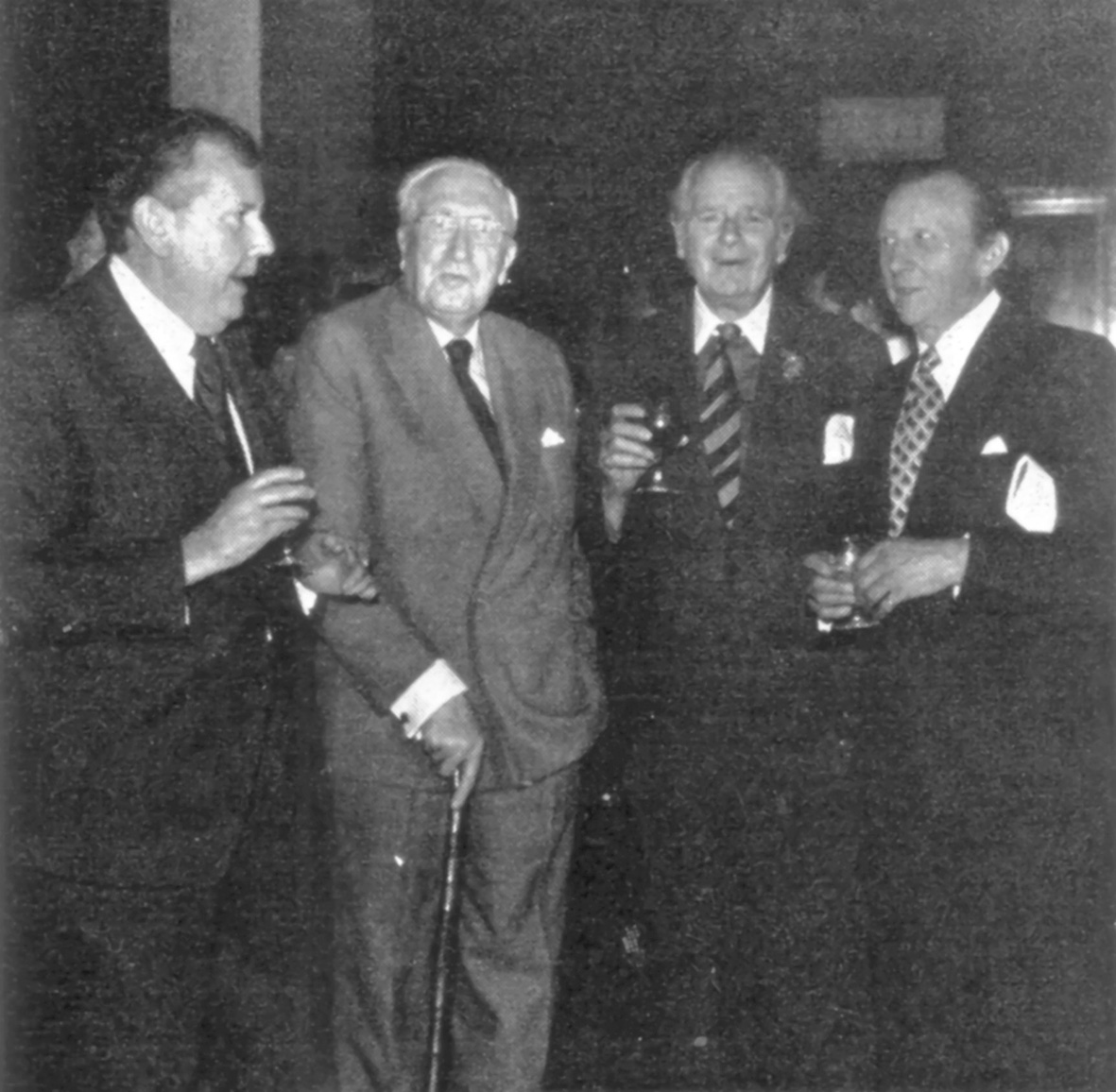
At the 1975 AGM of the PRS, when Lennox was elected President, a special guest was Jean-Alexis Ziegler, then Secretary General of the International Confederation of Societies of Authors and Composers (CISAC), in which PRS had always played a leading role. In a speech to members he emphasised how highly PRS was regarded by its sister societies in CISAC, citing ‘its sense of what is fair, its integrity, its courage and its realism’ as having ‘earned it much authority and much prestige among its sister-societies’, as evidenced by the fact that at CISAC’s most recent Congress the PRS had received the highest possible number of votes for representation on the CISAC Council. The late Sir Arthur Bliss had been elected as President of CISAC at the conclusion of its Congress in London in 1964, and, as we shall see, the election of Sir Lennox to a leading role in CISAC was not slow to follow his election as President of PRS.
In 1980 CISAC held its biennial Congress for the first time in an African country – in Dakar, the capital of Senegal – and for the first time Lennox, accompanied by Freda, was a member of the PRS delegation. The Congress and its associated events were memorable for a number of reasons – some good, some less so. There was some confusion about the local currency, denominated in francs worth only a fraction of the French franc, and thanks to Freda’s alertness, Lennox was saved just in time from paying a shopkeeper a quantity of French francs which would have increased the tradesman’s profit at least tenfold. At the Congress sessions themselves the debate topics included ‘a programme of assistance by CISAC for the promotion of copyright in developing countries’ and ‘challenges and promises of the mass media for copyright’, and at the final session the Polish author Karol Małcużyński (brother of the famous pianist) was elected President, and Sir Lennox Berkeley Vice-President.
In this new capacity Lennox attended the next Congress of CISAC in Rome in 1982, showing great fortitude and patience at having to sit on the platform through what seemed sometimes interminable debates on complex copyright issues. At the end of that Congress, in accordance with a tradition of choosing writers and composers alternately, Lennox was succeeded as Vice President by a Senegalese author, Birago Diop, while the Italian composer Roman Vlad became President in place of Małcużyński.
Throughout Lennox’s Presidency of the PRS, both he and Freda took a great interest in the welfare of the Society’s staff, and always attended the annual staff dinner and dance. On one of those occasions Freda rendered the present writer a signal service in lending him her reading glasses, without which he found he would have been unable to decipher his notes for his speech; this convinced him it was time for a visit to an optician for the first time in his life. On a much more memorable occasion Freda kindly undertook formally to open a recreation room which had been provided for the staff and was invited to throw the first dart at the gleaming new dartboard. With a confident flourish she released the dart from her grip – and scored a bullseye.
All those of us privileged to serve the PRS in any capacity during the years of Lennox’s Presidency look back on them with gratitude and affection.