Roger Butler’s Berkeley letters
Tony Scotland discovers a small cache of personal letters from Lennox and Freda Berkeley to their friend, Roger Butler
A folder of personal letters written by Lennox and Freda Berkeley to a friend, Roger Butler, who lost his sight as a young man, has surfaced following the publication of a new book about him.
The Light of Day by Christopher Stephens (Headline £20), tells the moving story of the author’s first meeting with Roger Butler, when, as a 21-year-old postgraduate at Oxford in 2003, he was asked to read to him; the close friendship which developed over the next eight years; and Christopher’s discovery after Roger’s death in 2011 that he had been a pioneer of gay liberation, when in 1960, with homosexuality still illegal, he had written a letter to The Spectator, starting, ‘Sir, We are homosexuals and we are writing because we feel strongly that insufficient is being done to enlighten public opinion on a topic which has for too long been shunned’.
The letter was prompted by the government’s failure to act on the recommendation of the 1957 Wolfenden Report that homosexual acts between consenting adults in private should no longer be a criminal offence, and it led, indirectly, to a change in the law in England and Wales in 1967.
The new Berkeley letters form part of a much larger collection of Butler’s letters and other papers inherited by Dr Stephens, who has kindly made them available to the Berkeley family.
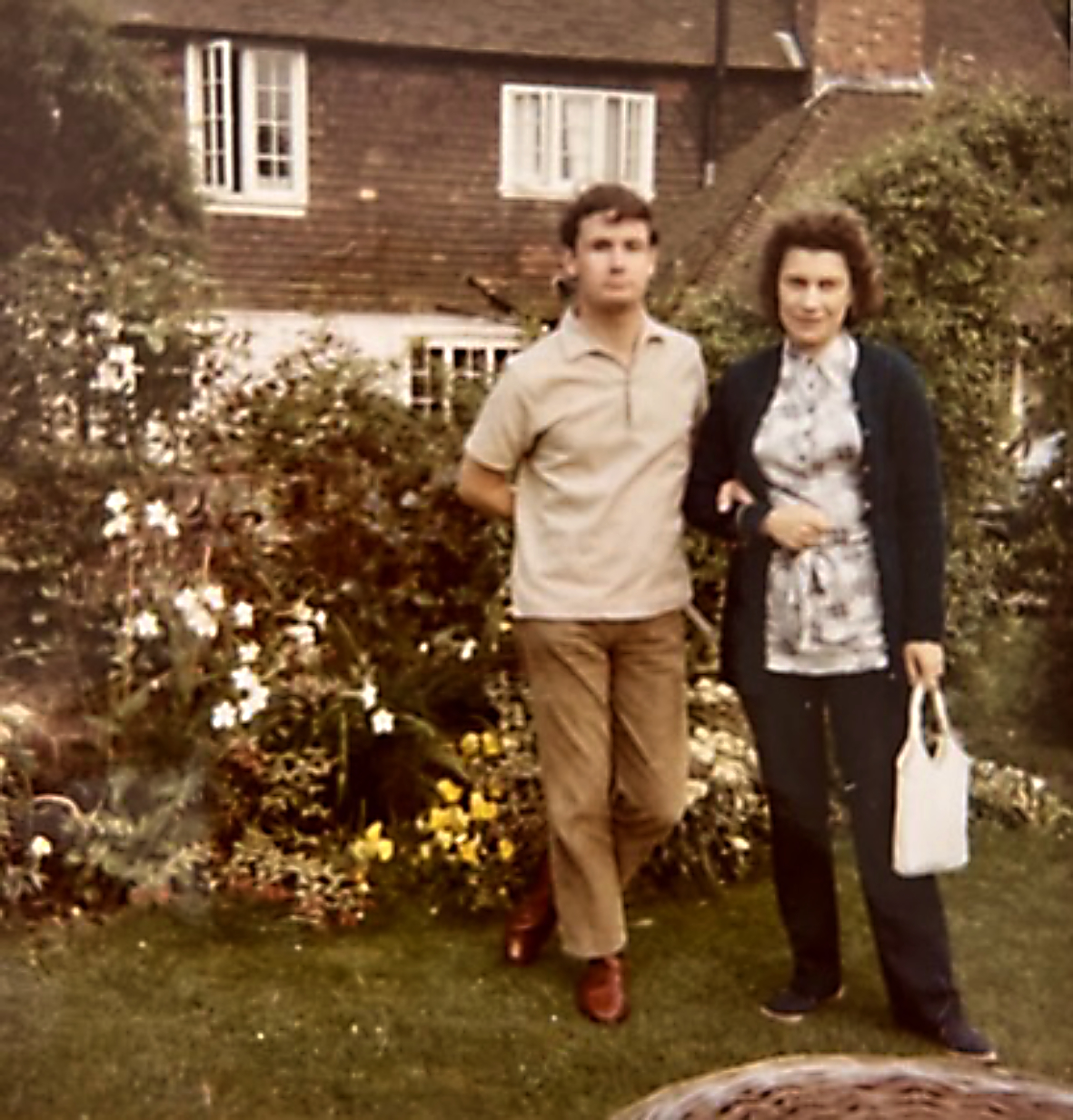
In a letter dated 24 August 1973, Lennox told Roger that he and Freda had just returned from the Three Choirs Festival at Hereford for the first performance of his orchestral piece, Voices of the Night. ‘It’s really simply a Nocturne’, he wrote, ‘in which I made no attempt to reproduce actual night noises such as the hooting of owls or the squeaking of ghosts, but rather to produce a nocturnal atmosphere. This I hope I did – anyhow the audience seemed to like it.’ Lennox was always strongly drawn to the form of the nocturne, and the music critic Rob Barnett has speculated that it might have been ‘the very isolation of sounds, undisturbed by the visual’, which attracted him; and that perhaps he was drawn to work for the BBC in the similarly 'isolated' medium of radio in the 1940s because it enabled him to concentrate on sound alone.1
Lennox made a comment on his Oboe Quartet in a letter dated 16 July 1975. ‘At the time I wrote it [autumn 1967] I was going through a phase of having slow and rather sombre endings to almost everything – it became an obsession which I’ve now got over, though I’ve always had a tendency towards it and probably always shall.’ He may have picked this up from the music of Fauré, whose late chamber works often end in a kind of resigned, twilight mood, or, more probably, from his friend Francis Poulenc, who, for all his music’s wit and sparkle, liked to end his later works, and his sacred music, in subdued reflection. So perhaps ‘slow and rather sombre endings’ are associated with a composer’s later life.
In May 1972 the Berkeleys were in Monte Carlo for the triennial Prince Pierre of Monaco Composition Prize, of which Lennox was a judge – with his friends, the teacher Nadia Boulanger and the composer Georges Auric. Nadia was then 85 and full of energy, Freda wrote at the time, but her sight was failing and a young pianist had to accompany her to the palace each day of the competition to play through every single one of a total of eighty submitted scores, so that she could judge their merit by ear.
Roger Butler’s papers also included a collection of newspaper cuttings about his friends. In one, in 1990, the Master of the Queen’s Music, Malcolm Williamson, wrote about the significance of Berkeley’s French connections, which started in childhood when his parents had houses in Nice and Fontainebleau, and were consolidated in the late 1920s and early 1930s when he himself lived in Paris while studying with Boulanger. It was at that time that he was received into the Roman Catholic Church, which, as Dr Williamson wrote, forged another, deeper link with France.
While his deep, enduring and questing faith was too private for table-talk it informed his music, sacred and secular, as it did his life. … Berkeley elected French influences and thereby benefited not for any inherited reason, but out of a personal decision to live and work where he would, and did, best mature. Let it not be forgotten that Boulanger was half-Russian, and that in Berkeley’s Paris Stravinsky was a towering and controversial figure. Beneath the surface of Berkeley’s persona and music, with the evident charm and modest courtesy, are depths of resolute wisdom and deliberate strength of purpose. 2
Malcolm Williamson had the greatest admiration for Lennox Berkeley, both as a composer and a musician, and, in his obituary of Berkeley earlier in 1990, he wrote that in his view Berkeley was ‘a composer of the highest eminence’.