The Francis Family’s musical links with Lennox Berkeley
The oboist Sarah Francis looks back at her family’s connections with Lennox Berkeley that spanned nine decades
On 5 November 1929 in the Concert Hall of the Royal College of Music there was an evening recital by the Sylvan Trio, recently formed by three senior students, Sylvia Spencer, oboe, and my parents, John Francis, flute, and Millicent Silver, piano. The programme included a trio by Eugene Goossens, and another composed for them by the pianist/composer Alec Rowley, piano solos by Bax and Brahms, oboe solos by Marcello and Delius, and flute solos by Bach. Years later I had a first-hand account of this recital from the oboist Natalie Caine, then a piano student, who, despite competition from fireworks outside, was so inspired by Sylvia’s playing that she went to Leon Goossens and asked him to teach her how to make ‘that magic sound’.
In the uncertain climate of the 1930s the Sylvan Trio gave concerts in music clubs, libraries and schools. During the late 1920s the BBC had expanded its output of chamber music, and the Sylvan Trio passed an audition and started broadcasting from Savoy Hill. They broadcast almost every other month on the National or Regional Programme, usually in the 4.20pm slot on a Tuesday: ‘A Light Classical Concert’, often with Millicent accompanying a singer, such as the soprano Margaret Field-Hyde singing Handel and Ravel, or Stanley Pope, baritone, singing Bantock. On one occasion a public concert was relayed from the Houldsworth Hall, Manchester. Programmes were a mix of eighteenth-century and some twentieth-century pieces. But the Sylvan Trio needed more repertoire, so Sylvia set about writing letters to composers requesting pieces. One of these was to Lennox Berkeley, who replied from his parents’ villa at St. Jean Cap Ferrat, on 25 March 1934:
Dear Miss Spencer,
I will certainly try and write something for flute, oboe and piano, but I cannot promise it, as I have other things on hand and have been very busy lately. It sounds rather an odd combination but I have no doubt that it can be made to sound well, and I think that a composer who knows his job ought to be able to write for any combination of instruments. Anyhow I will have a shot at it, and if circumstances permit I will send you something by the beginning of May.
Yours sincerely,
Lennox Berkeley
It was strange for Lennox to call the combination of flute, oboe and piano ‘odd’ but in the late 1920s and early 1930s it was unusual for a music club to include a wind and piano ensemble in their season of concerts. String quartets and piano trios or recitals were the norm. In the 18th century woodwind soloists often played in chamber concerts but rarely in the late 19th and early 20th centuries. In fact we have Leon Goossens to thank for making the woodwind recital popular in Britain.
Lennox was busy working on several pieces, including the Overture Op 8, and Jonah. In September 1935 he came over to London to conduct the BBC Symphony Orchestra in the British premiere of Overture at the Proms. We know that by then, 18 months after Sylvia’s original request, the Flute, Oboe and Piano Trio had been composed and presented to the Sylvan Trio. The manuscript has no title page, so either there never was one, or it is lost. The movements are:
I. Prelude – Andante con moto II. Allegro moderato
III. Moderato (scored for piccolo and cor anglais) IV. Fugue – Allegro
In Sylvia Spencer’s diary for 1935 there are two entries for rehearsals: ‘October 17 ... Lennox Trio 2.30 p.m. ...’ and, in pencil, ‘October 23 ... 3.0 p.m. Trio ...’ (followed by ‘Lennox’ in ink, which may suggest that he indicated subsequently that he would be coming to that rehearsal). It was on this later occasion that he reallocated a few bars in the first movement from the piano’s right hand to the flute part.
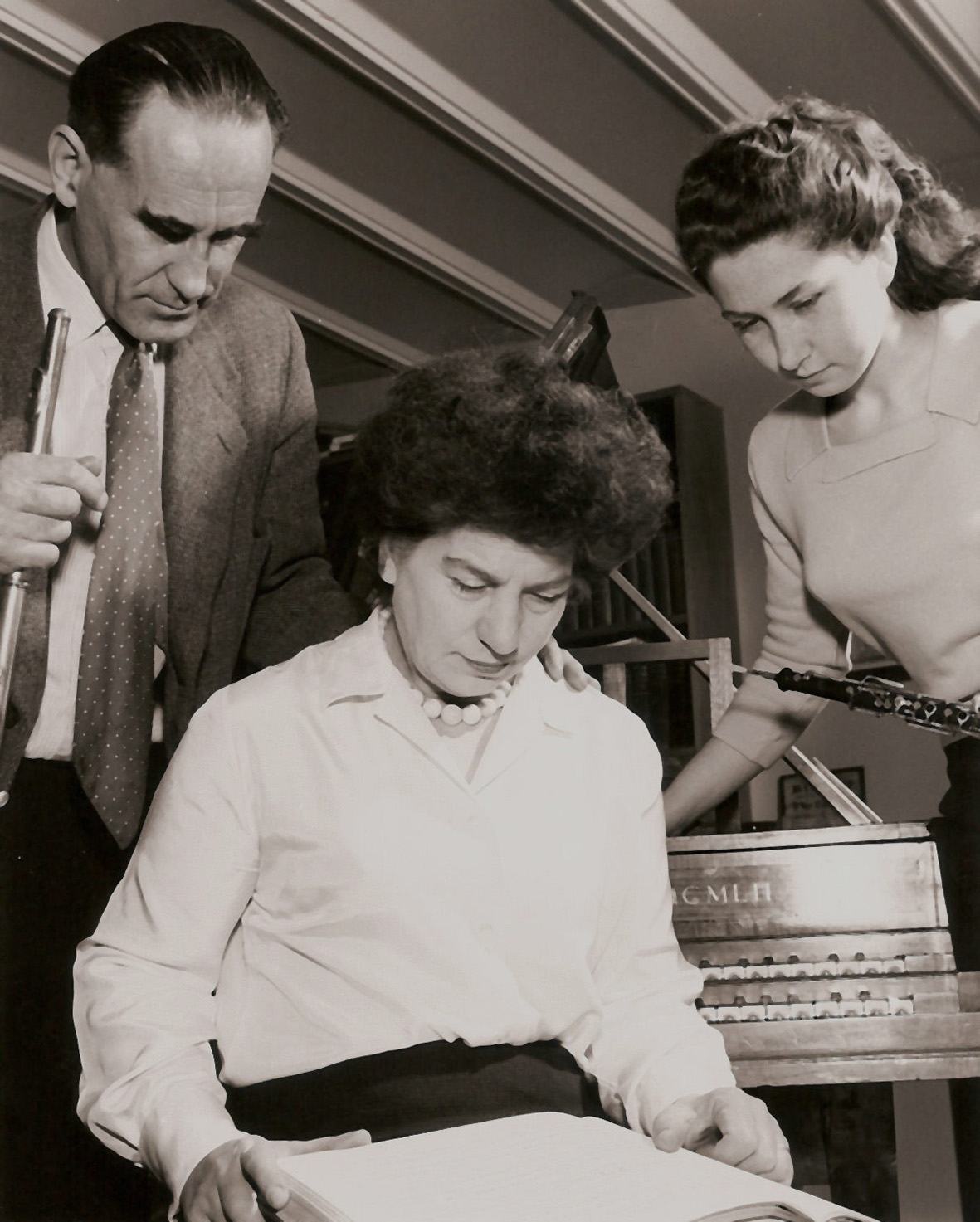
The Sylvan Trio were clearly working towards an imminent first performance. We have no evidence of where the première took place, but on March 15, 1936 they gave a broadcast performance of the Trio on the British Empire Broadcasting Service. For some reason it was billed as Four Pieces, with the third movement entitled ‘Dance’. In fact this movement is a rumba, and someone may have thought that Dance sounded more glamorous than simply ‘Moderato’. Judging by the well-thumbed state of the MS, the Sylvan Trio played the work many times.
Walter Leigh also composed a trio for them in 1935. The following year Sylvia married Ian Anderson and moved up to Scotland, but she returned to London occasionally to do some playing. Natalie Caine later joined my parents as oboist in the Sylvan Trio, followed by Joy Boughton.
The next Francis family link with Lennox was in November 1936 when Lennox’s Deux Poèmes, a setting for percussion, piano and strings of two hymns to athletes by the Greek poet Pindar, was performed in the Queen’s Hall in a concert with the LSO and Nadia Boulanger. Benjamin Britten was scheduled to play the piano part, but could not make the date so he asked my mother Millicent Silver to take his place.
During the war the Sylvan Trio gave CEMA concerts in factories and work canteens. Not surprisingly some of the pianos were dreadful, with keys sticking and ivories missing. After the war there were school concerts, often twice a week. In Essex an enlightened council had groups giving six concerts a day in primary and secondary schools, and a flute, oboe and piano trio was a good combination for these.
My own first encounter with Lennox was when I was about 10. He and Freda were coming to dinner with my parents in London. I was in a panic over my French homework, and my mother, in desperation, and knowing that Lennox was bilingual, said to me, ‘Why don’t you ask Lennox to help you?’ Kind Lennox sat down with me and together we finished my homework. If the teacher noticed that some of the writing was suspiciously neat, with the accents pointing the right way, she never said anything.
I first heard music by Lennox when we shared a house with Leonard Isaacs and his family in Greville Place, Kilburn. We had the ground floor and basement. My room was next to the music room where my mother’s grand piano lived, and rehearsals took place. I would drift off to sleep to the strains of Bach or Haydn played not on the gramophone, but by live musicians. There was a magical piece for flute and piano which my parents frequently practised; I loved it. There was something supernatural about the way the flute floated up, and it ended with an exciting wild dance. Much later I realised that the piece was Lennox’s Sonatina for recorder or flute and piano, composed for Carl Dolmetsch in 1939. What a masterpiece! My parents gave many performances of it, including one on French Radio around 1960. They also had in the repertoire of their London Harpsichord Ensemble Lennox’s Concertino Op. 49 for flute, violin, cello and harpsichord, which they often played in their concerts in the Royal Festival Hall Recital Room. Lennox Berkeley was one of the few composers who understood how to write for the harpsichord in the 20th century.
My father was closely involved in the early years of the Aldeburgh Festival. Sometimes we stayed there in a holiday flat: it was really nice staying in Aldeburgh. We frequently saw the Berkeleys, and there were outdoor madrigal concerts and garden parties. The children of members of the orchestra got in to see the dress rehearsals. I liked A Dinner Engagement with Flora Nielsen as the Grand Duchess of Monteblanco, and it was fun cycling along the front and seeing characters from Britten’s opera Albert Herring walking down the street and his Etruscan Prince Tarquinius paddling on the beach.
My mother greatly admired Lennox, and asked him if he would be interested in composing a flute concerto for father. The result was the Flute Concerto Op. 36. John Francis gave the first performance in July 1953 at the Proms with the BBC Symphony Orchestra conducted by Sir Malcolm Sargent. It was very well received, and the notices speak for themselves:
Lennox Berkeley’s Concerto for Flute is a full-length work (four movements) which despite the light calibre of the solo instrument amazingly manages to say a number of serious worthwhile things. What brilliance there is in it – and there is quite a lot – subserves the musical thought, and though the composer makes use of a full orchestra, his sense of balance is faultless. This is certainly a work that makes a noteworthy contribution to the scanty literature of this genre. John Francis was the excellent soloist. [Time and Tide]
Lennox Berkeley’s Flute Concerto [is] clearly designed to exploit the resources of both flute and flautist, from whom considerable technical proficiency is demanded, but the orchestra has an equally important share in the whole. The two middle movements, a Presto and an Adagio, are particularly fine. The former, a brilliant and scintillating free scherzo, commands admiration for this composer’s skill, and in the Adagio one listens to lyrical melody of a kind all too rarely heard in contemporary music…… the work drew cheers for the composer – just as his delightful Two-Piano Concerto did at a Prom four years ago. [Noel Goodwin]
Although the fast passagework in the scherzo lost its brilliance in the re-echoing vaults of the hall [this was before the correction of the Albert Hall’s echo problems], the nobly elegant lyrical adagio defeated all obstacles and confirmed my suspicion that the whole work was, in all probability, much better than it was sounding on this occasion. John Francis, for whom the work was written, played with fine musical feeling and a nice sense of phrase and tone colour. [The Spectator]
The Staffordshire Evening Sentinel had a different opinion, following a performance in Stoke-on-Trent. After some dismissive remarks about the ‘tootling’ flute as a solo instrument, it concluded: ‘Mr. Berkeley’s concerto chatters cleverly in the contemporary manner, but one may face with composure a lifetime spent without hearing it again’.
Lennox was a friend and colleague of the distinguished oboist Janet Craxton and her brother, the artist John. Janet and Lennox were both teaching at the RAM in 1962, when he composed the Oboe Sonatina for her and dedicated it to both her and John (who paid for it with a painting of Crete). The first performance was given by Janet with her husband, the composer and pianist Alan Richardson, at the Wigmore Hall in November 1962. I really like the Sonatina, which is so well written for the oboe. We all heard Janet and Alan give a lovely performance at Lennox’s 70th birthday party in the presence of Nadia Boulanger. Janet was a great player, and fortunately for oboists Lennox went on to compose the Oboe Quartet and the Sinfonia Concertante for her. Peter Dickinson and I have programmed the Sonatina many times, including performances at the Barber Institute in Birmingham, in the Purcell Room, and in March 1990 at a concert that included the first London performance of Jonah organised and conducted by Jonathan Rennert at St. Michael’s, Cornhill.
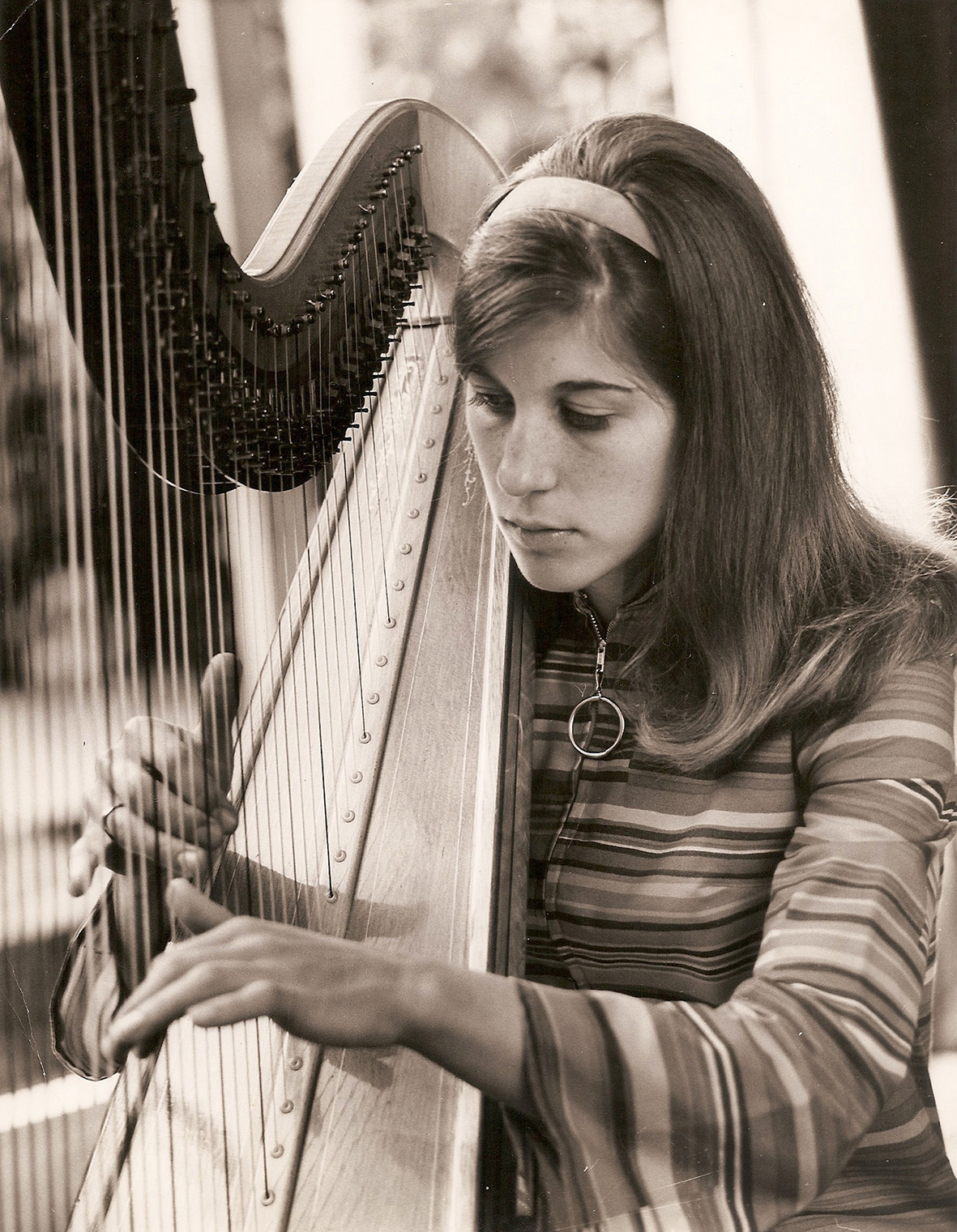
My sister Hannah has had two careers, as a harpist and a soprano. She recalls dining with our parents at the Berkeleys’ house in Little Venice, with ‘beautiful Freda and the refined, handsome Lennox’. By now Julian Berkeley was having flute lessons with Father at home in Marlborough Place, and later studied with him at the Royal College of Music. After Hannah had won the Royal Overseas League Competition as a harpist in 1966, Lennox composed his Nocturne for solo harp for her to play in a Wigmore Hall concert. Although Lennox had included a harp in many of his works, before he embarked on this solo piece he took the trouble to visit Hannah and to hear her playing something she enjoyed – she chose Notturno by Lex van Delden. They then discussed in detail the technicalities of the harp. Following the Wigmore Hall première of the Nocturne, Hannah broadcast it for the BBC and played it often in the UK and in Holland.
In 1980 Peter Pears invited the cellist Rohan de Saram and myself to give a duo recital at the Aldeburgh Festival, playing Lennox’s Petite Suite from 1928 – another attractive youthful piece – together with the Little Epiphany variations composed for us by Gordon Crosse, Britten’s Six Metamorphoses after Ovid for oboe solo, and two pieces for cello solo, Bach’s Suite No 3 in C, and the finale of Kodaly’s Sonata.
In June 1988 Peter Dickinson presented a series of four programmes for BBC Radio 3 on the theme of ‘The Young Lennox’, marking Lennox’s 85th birthday, in which he and I took part. We included both the Petite Suite and the Trio for Flute, Oboe and Piano, which had not been played for many years. My father had by then passed on to me the MS of the Trio, in the brown paper envelope in which it had survived an almost direct hit on my parents’ house – safe in a set of solid oak drawers on the concrete floor of the basement.
The flautist Judith Fitton and I – together with Michael Dussek, piano – have recently recorded the Trio on a CD of Lennox’s chamber music, together with the Tagore String Trio playing Lennox’s String Trio Op 19. When I was looking for a piece to bring together strings and wind on the CD, I was delighted to find the manuscript of Lennox’s Suite for flute, oboe and string trio in the British Library – and initially astonished to see every part signed ‘John Dursley’ in Lennox’s handwriting. The explanation is to be found in Tony Scotland’s Lennox & Freda. Lennox had been so hurt by criticism from Gordon Bryan in the Monthly Musical Record that he adopted a family name as a pseudonym, though fortunately not for long. As we all worked together on the Suite we became captivated by it.
My mother died on Thursday May 1 1986, after a long illness. I had been booked to play two concerts the following weekend with the Cummings String Trio at Rangers House, Blackheath, and Kenwood House in Hampstead. The programme was like a special memorial concert for my mother: Lennox’s Oboe Quartet, Beethoven’s String Trio in G and the Mozart Oboe Quartet. Lennox and Freda came to the concert with Julian. Lennox, already suffering from Alzheimer’s, looked frail but also pleased, and their presence was a great support.
In writing this article I realise that the post-war period, when I was a child, saw the renaissance of musical events in Britain. I was fortunate to be surrounded by so much good music, great musicians and lovely people like Lennox and Freda Berkeley.