The ‘beauty and pleasure’ of composing for piano
A personal assessment of Lennox Berkeley’s piano music by the American writer Benjamin Ivry
Lennox Berkeley and Friends: Writings, Letters and Interviews, published in 2012 by Boydell & Brewer, convincingly establishes that Lennox Berkeley (1903–1989) was a distinguished composer of music for the piano. Edited by the British composer and pianist Peter Dickinson, who also wrote The Music of Lennox Berkeley (Boydell, 2003), the book describes a composer who was an able, although not virtuoso, pianist whose keyboard ideal was formed by hearing performances by Vladimir Horowitz and Walter Gieseking. After a 1930 Paris concert where Gieseking played Beethoven’s ‘Emperor’ Concerto, a published review by Berkeley states: ‘The piano seemed to have more variety of tone colour than the orchestra.’ Since on that occasion the orchestra was conducted by Bruno Walter, this is high praise indeed.
One year later Berkeley enthused about further performances by Gieseking for their ‘utter absence of show and exterior effect... one had the feeling of listening for the first time to things that one knew by heart.’ In 1939, as Berkeley was finishing his Four Concert Studies, he wrote wistfully to Nadia Boulanger that Horowitz would be ‘needed’ to play them, but that the Russian pianist was unlikely to embrace the new works: ‘Like most virtuosos he’s probably not dying to play modern music’.
Fortunately Berkeley found a skilled virtuoso to take up his piano works, the able New Zealand-born Colin Horsley [whose death in 2012 at the age of 92 is recorded elsewhere in the Journal]. Horsley’s authoritative recordings of Berkeley’s piano music, recently reissued on CD from Lyrita provide a solid argument for their validity, furthered by a Chandos series of CDs with performances by Kathryn Stott, Howard Shelley, and Margaret Fingerhut. The results illuminate a number of works which deserve to be embraced by European pianists, and not just championed by the British.
Berkeley’s Piano Concerto in B-flat major (1947–8) is a modernist echo of concertos by Camille Saint-Saëns in its balletic gusto. Berkeley includes challenging passages with double octaves, as part of his unrequited love affair with the playing of Horowitz, in this elegant and fluent work. A chortling, good-humored, elfin, final movement is marked ‘Vivace – alla breve’. For Horowitz, and perhaps some other virtuosos, the music might lack diabolic, audience-impressing drama. Instead, this concerto is a light-hearted comedy of manners, like Berkeley’s best opera, A Dinner Engagement.
Berkeley’s Six Preludes (1945) are similarly sprightly, with a fairyland spirit which is impish in the way Mendelssohn’s works can be. UK critics, in a somewhat misleading way, continually claim that Berkeley’s music ‘sounds French’, and, although he loved France, spoke the language fluently, was a close friend of Maurice Ravel and studied with Nadia Boulanger, this did not diminish his Britishness. Only by agreeing with British critics’ assumptions that ‘British’ means heavy, sombre, and overbearing, while music which is witty, delicate, charming and endearing cannot be British, does Berkeley’s work sound genuinely more Gallic than a product of his native land. Others of his Preludes have a wistful salon-style melancholy from the universe of Chopin, another composer he admired greatly. Affectionate regret is expressed without heavy tragedy intruding, always in a lilting, dancing style. A 1993 recital on CD (Wigmore Hall Live CD – WHLIVE 0014) by Shura Cherkassky includes works by Berkeley which seem to belong to an era when taking pleasure, and even the notion, now-widely despised by snobbier critics, of having ‘fun’ from music, was not forbidden.
Berkeley’s own relationship to pleasure was unusually complex, as a 2010 biography, Lennox and Freda by Tony Scotland (Michael Russell Publishing; lennoxandfreda.com) explains. After a series of more or less ill-fated gay male relationships, including one with Britten, Berkeley decided in his early forties to marry a female secretary twenty years younger than he, and they lived happily ever after, raising three sons. Berkeley would later complain that some composers ‘confuse beauty with pleasure’, citing as an example his good friend Francis Poulenc, some of whose works Berkeley termed ‘hit or miss’. In a letter to the sternly puritanical Boulanger in 1946, Berkeley wrote about composers:
I think that certain natures easily confuse beauty with pleasure and have to make a continual effort to keep them apart – Poulenc for instance is apt to do this, but though it is dangerous to people like him and me, it is perhaps a good thing that the element of pleasure should return to music after all the grim and false austerity of the 1920s. Stravinsky has the true austerity, and at the same time pleasure is by no means absent from his music.
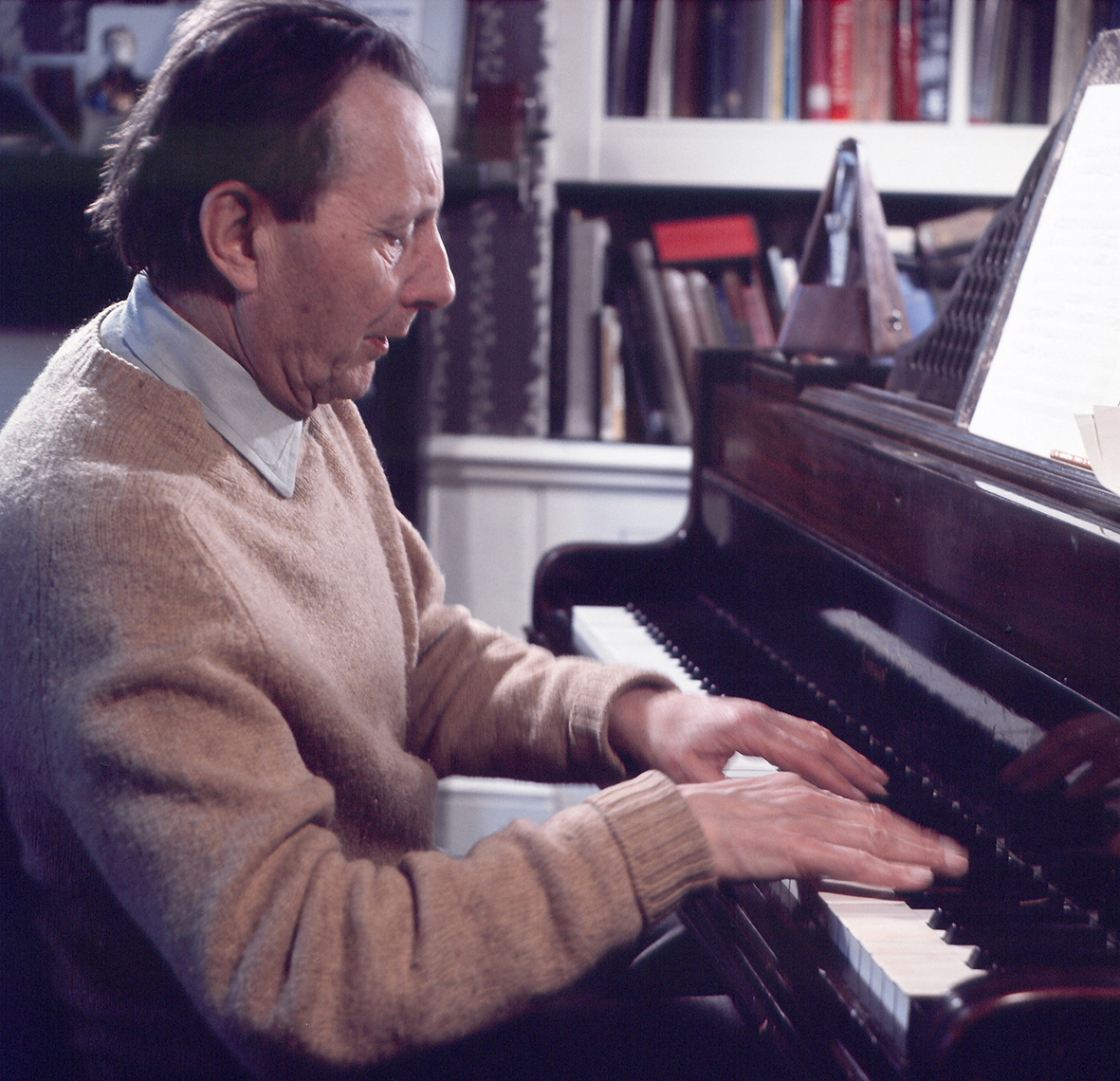
Replacing decades of gay experience with Catholic piety and a tight-knit family circle, Berkeley may have also been affected early on by the Alzheimer’s disease which would dominate his last years. As doctors now know, signs of Alzheimer’s may become visible decades before the illness becomes an overwhelming problem in some patients. Whatever the reasons for his unusual change of life – gay contemporaries such as the poet Stephen Spender and the conductor Leonard Bernstein also married and sired children but continued to have gay love affairs, while Berkeley to all evidence did not – it worked out productively for Berkeley. The French Catholic author Julien Green, who is identified in Lennox Berkeley and Friends as a kindred spirit and alter ego, spent decades in torrid gay affairs before deciding well into his sixties to offer his future celibacy as a gift to God. Green himself saw nothing absurd in this, nor would Berkeley, an avid read of the French author’s monumental Journal, have done so.
Even so, not all of Berkeley’s friends approved of his surprising marriage. Decades after his close relationship with Britten ended, Berkeley noted in his diary for 1972: ‘I find [Britten] rather lacking in warmth and real friendliness – his character seems somehow changed.’ An acute observer of others, Berkeley dedicated his early Three Pieces (1935) to friends whose personalities he acutely evoked in the works themselves. Virgil Thomson did this kind of thing in his musical ‘portraits’ of friends and colleagues, but far less successfully than Berkeley. The first of the Three Pieces, ‘Etude: Allegro moderato,’ is dedicated to ‘Miss Harriet Cohen,’ the famous British pianist (1895–1967) who for over forty years was the mistress of the noted composer Sir Arnold Bax. Berkeley’s Etude captures Cohen’s flamboyance, with boldly forthright, stubbornly adamant phrasing, representing the lady’s firmly assertive character. The second of this set, Berceuse: Allegretto is a child-like reverie dedicated to an early lover of Berkeley’s, Alan Searle, a young man who would suffer in later years when working as the personal secretary of the sadistic novelist Somerset Maugham. The final segment, Capriccio: Allegro is a burlesque jeu d’esprit with a dazzling dash of Spanish fandango-like rhythms, dedicated to Berkeley’s roommate in Oxford and London, Vere Pilkington, an avid harpsichordist who introduced him to early music.
Other piano works by Berkeley also express such tributes to the personalities of friends. Paysage (1944), a gently meditative pastoral, is dedicated to a waspish gay literary critic, Raymond Mortimer, who was regularly mocked for his homely appearance by Jean Cocteau, who called him ‘l’affreuse bergère’ (the frightful shepherdess). Berkeley obviously saw other qualities in Mortimer than some in their social circle would admit, and the resulting Paysage is ultra-British in its expression of the nobility of rural inspiration.
More character is revealed in Berkeley’s works dedicated to Horsley such as Scherzo in D Major Op. 32 No. 2 (1949), in which the brightly animated virtuosity seems to represent the New Zealand stand-in for the still-absent Horowitz. Berkeley’s Piano Sonata in A Major Op. 20 (1945), also championed and recorded by Horsley, is very Schubertian in inspiration, aptly enough for a work dedicated to the distinguished Schnabel pupil Clifford Curzon, a great performer of Schubert, like his mentor. The Sonata in A Major further captures Curzon’s personality in its pensive, quietly questing sensibility.
Berkeley’s Improvisation on a Theme of de Falla, Op.55 No. 2, inspired by a passage from Manuel de Falla’s El amor brujo (Love, the Magician) is stark, spare, and spookily evocative of Falla’s own aesthetic. For a composer who was supposedly so very French, it is striking how Berkeley was able to enter the Spanish idiom (without even considering the works which he would write for the splendid English guitarist Julian Bream, which would also draw on Spain for inspiration).
Sometimes for Berkeley the piano was more than just an instrument to evoke the character of people whom he magically loved. It became a character in itself, as in his witty and elegant high society opera A Dinner Engagement, written in 1954 to a libretto by the poet Paul Dehn (who also wrote the libretto for William Walton’s Chekhov opera, The Bear, as well as the stylish screenplays for the films Goldfinger, The Spy Who Came in from the Cold, and Murder on the Orient Express. In A Dinner Engagement the piano is used as continuo instrument, but its music is composed like a harpsichord part to be played on the piano, in the old style of performances heard at the Glyndebourne Festival in the 1930s, conducted by Fritz Busch. In the writing for piano in A Dinner Engagement Berkeley ingeniously blended neo-classicism, modernity, and even nostalgia for Busch’s pre-war glories, fortunately recorded at the time and still available on CD. Berkeley’s rich legacy of writing for the piano likewise deserves to be remembered and relished.