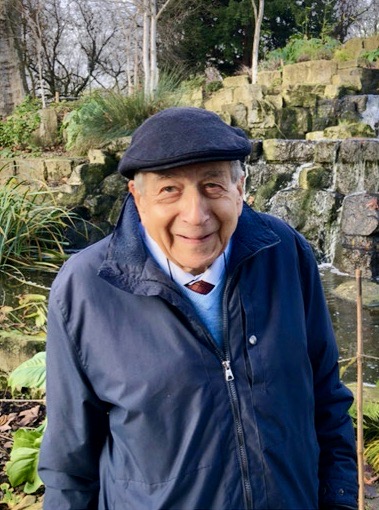
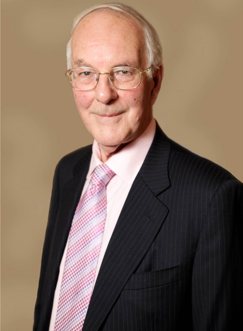
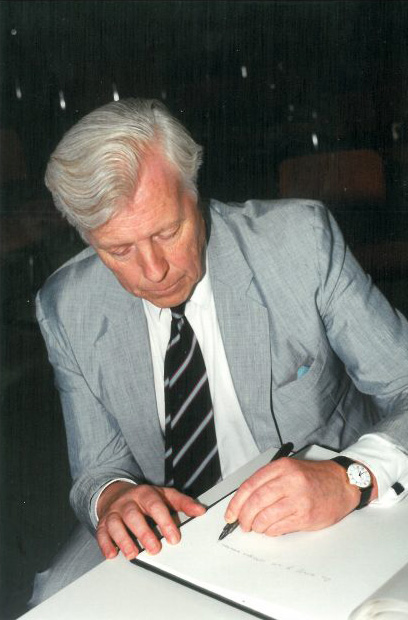
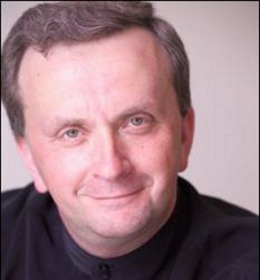
The Lennox Berkeley Society has learned with great sadness of the death of one of its founder members, the distinguished copyright lawyer Jack Black, a former chairman of the Cheltenham Music Festival and a lifelong friend of music. He died in hospital in London on 30 November, aged 91, and the funeral was at St. Marylebone Crematorium, London N2, on 13 December, when mourners were invited to wear colours, in celebration of Jack’s life.
Jack Black was Chairman of the Cheltenham Music Festival when Lennox Berkeley was its President and John Manduell its Programme Director, and he remained a much-loved friend of the Berkeleys till the end of their lives. But music was only one of the many strings to his bow: he was also keenly interested in cricket, astronomy, the theatre, travel and Latin – in his later years he enjoyed reading Winnie the Pooh in translation as Winnie ille Pu.
As senior partner of Heald Nickinson and then Radcliffes, Jack specialised in copyright, patent and European law. In 1977, with another long-standing member of our Society, Michael Freegard, a former Chief Executive of the Performing Right Society, he published a standard reference work on collective copyright licensing, Decisions of the UK Performing Right and Copyright Tribunal. His clients included Bertrand Russell, John le Carré, Julie Christie and Lennox Berkeley.
Jack had an unusually harrowing childhood. He was born as Jacob Sänger in Hamburg, where his father, Willi, was Treasurer of the Orthodox Jewish Community. In 1938, during the anti-Jewish riots known as Kristallnacht or Night of Broken Glass, Willi was violently attacked by Storm Troopers and Hitler Youth, and shortly afterwards he took the decision to send six-year-old Jacob to safety in England on the Kindertransport, with thousands of other children fleeing the Nazi pogroms. Willi and his wife couldn’t follow him because they had to stay in Hamburg to look after their other son, Erwin, who had Down’s Syndrome.
In England Jacob was taken in by Charles Black, a hat-maker, and his wife Sophie, who spoke to him in his Yiddish till he could learn English. It was they who had to break the terrible news, after the war, that his parents and brother and other family had all perished in the Holocaust.
Meanwhile disaster had struck Charles Black himself in 1940 when his factory in London was bombed during the Blitz, and he had to move the family out of London to Stoney Stratford in Buckinghamshire, where he rebuilt the business.
At school at Hendon County High, Jacob, now Jack, met the woman who was to become his wife of sixty-eight years, Dora Braham, later an internationally-known child psychiatrist. As a boy Jack wanted to become a Latin teacher but his adopted father wanted him to study law. And so he did – at University College, London, while Dora studied medicine at the only university that would then take women medical students, Birmingham University. Later Jack did his National Service as an army officer, practising his his knowledge of the law in defence of soldiers facing courts martial. Jack and Dora married in 1955 and had three children in quick succession in the early 1960s. They are survived by two of them, Sophie and Andrew, and a grandson, Matthew.
Jack Black was not only exceptionally clever but protean in the breadth of his interests and accomplishments, but he will be remembered best perhaps for his gift of friendship. He had a soft spot for the Berkeley Society and attended all our annual meetings, even last year when he was ninety and far from well. His warm smile and twinkling eye as he greeted old friends, who guessed it might be for the last time, felt like a benediction which they will long treasure.
Peter Dickinson
15 NOVEMBER 1934 – 16 JUNE 2023
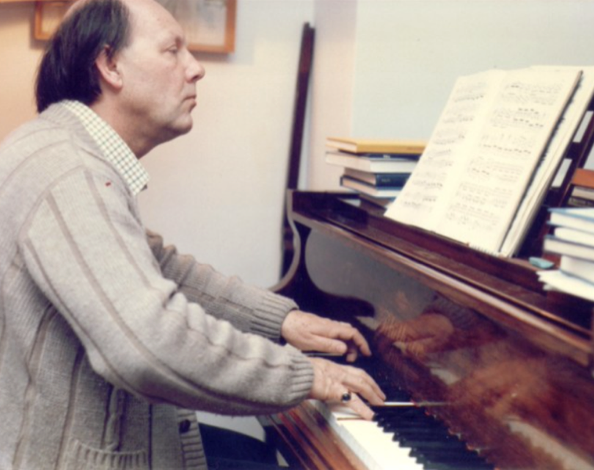
The Society announces with great sadness the death of Professor Peter Dickinson, composer, musicologist and pianist. He died in hospital, after a short but serious illness, aged 88. As Norman Lebrecht wrote on his classical music website, Slipped Disc, Peter was a ‘polymath … of ceaseless curiosity’. A Juilliard graduate from Lytham St Annes, he was an authority on American music, from Ives and Cage to present-day composers, first professor of music at Keele in 1974 and later teacher at Goldsmiths in London. He composed concertos for organ, piano and violin, as well as a vast amount of vocal music, much of it performed with his sister, the mezzo-soprano Meriel Dickinson. Classical Music magazine wrote that ‘he deserves his place among music’s elder statesmen.’ Peter was one of the best informed and most constant advocates of the music of Lennox Berkeley. Along with other books on Billy Mayerl, Aaron Copland, John Cage, Lord Berners and Samuel Barber, he wrote the composer’s definitive musical biography, The Music of Lennox Berkeley (Boydell, second edition, 2003). He also edited a volume of writings by and about Berkeley, Lennox Berkeley and Friends (Boydell, 2012), and produced a lifetime of miscellaneous articles and reviews. Peter made many recordings of the music, some of them with his sister Meriel. As he explained in a long article in the current (2023) issue of the Society Journal, he first came across Berkeley’s music while he was still at school, met the man himself not long afterwards and, with his wife Bridget and sister Meriel, remained close friends of Lennox and Freda and the family. Peter Dickinson was the acknowledged authority on Berkeley’s music, constantly consulted by musicians, publishers and other musicologists for guidance on ambiguities in manuscripts and published editions. He will be greatly missed by a wide circle of family and friends, by an ever wider circle of colleagues and collaborators throughout the world of music, by the young musicians who were beneficiaries of the Rainbow Dickinson Trust, and by all of us in the Lennox Berkeley Society, of which he was a founder member, a former Committee member, and a senior Patron.
A Berkeley Celebration
Saturday 20 May 2023
A celebration of the 75th birthday of Michael Berkeley CBE, the 120th anniversary of the birth of his father Lennox Berkeley, and the 400th anniversary of the death of William Byrd, featuring the premiere performance of a new work by Michael Berkeley, Released by Love, and a Q&A with the composer led by Petroc Trelawny.
7.30pm at Hampstead Parish Church, London NW3 6UU. Tickets £15/£12, Book online. Door sales available. Parking is limited close to the church.
Gibbons Variations live in London
October 2022
Michael Waldron, Artistic Director, LCS
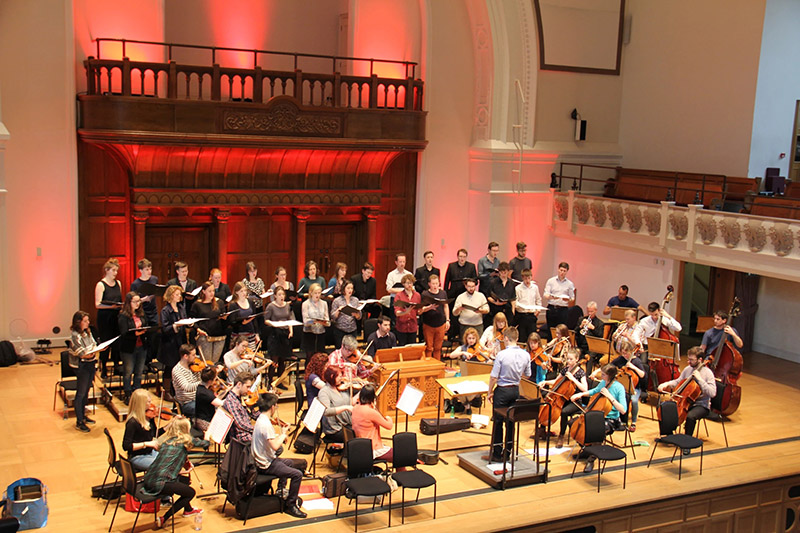
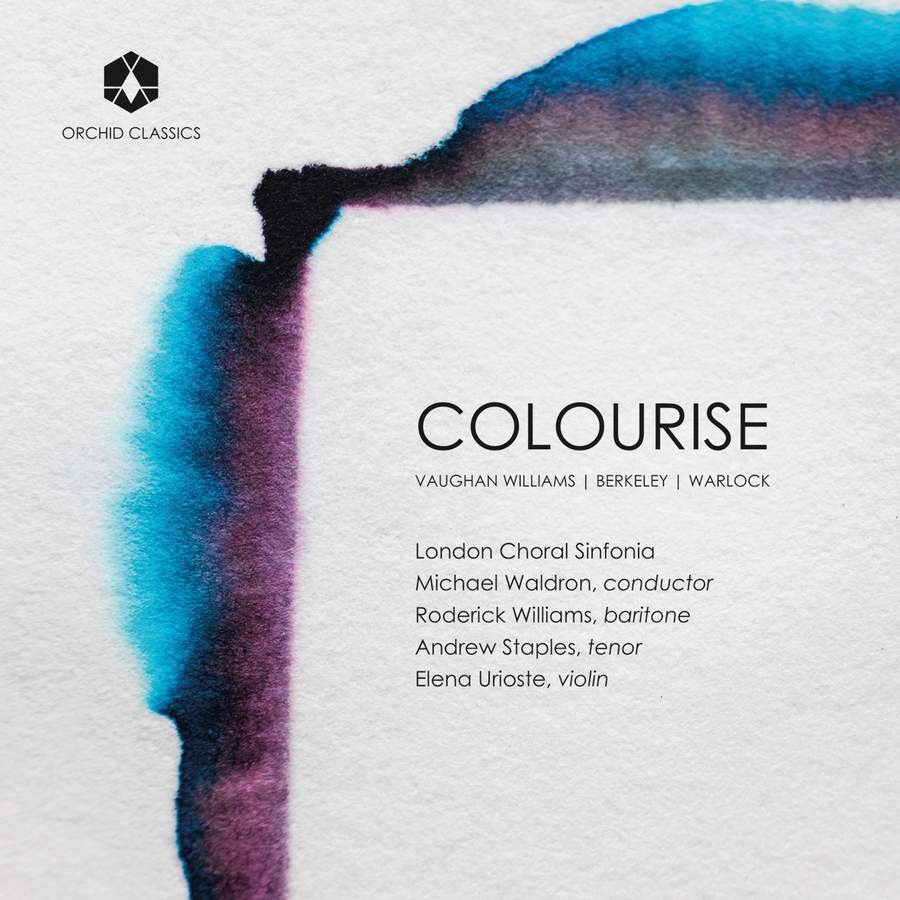
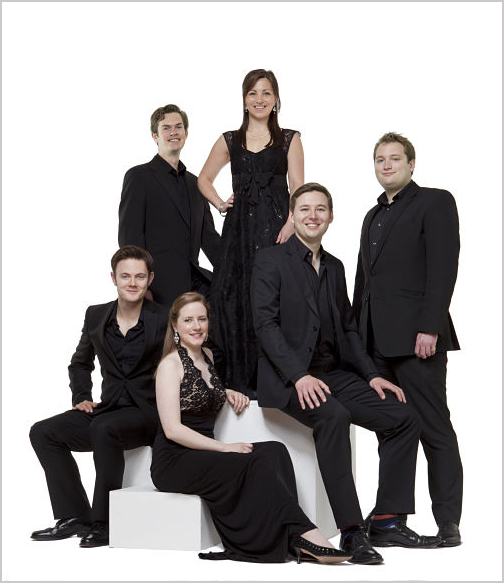
One of Lennox Berkeley’s finest but least-known choral works, the Variations on a Hymn Tune by Orlando Gibbons, is to be given its London premiere at the Cadogan Hall on Wednesday 19 October at 7.30pm. The performers will be the tenor Nick Pritchard and the London Choral Sinfonia (director, Michael Waldron), whose premiere recording of the work was released in July on the CD, ‘Colourise’ (Orchid Classics ORC 101200). Gibbons’ original hymn tune is known as Song 20, which was set to the words ‘My Lord, My Life, My Love’ (No. 442 in The English Hymnal), by the early eighteenth-century Congregational minister and theologian Isaac Watts, and Berkeley scored his six variations for tenor solo, chorus, string orchestra and organ. He was commissioned to write the work by Britten’s English Opera Group, which gave the first performance at the Aldeburgh Festival in Aldeburgh Parish Church on 21 June 1952, with Peter Pears taking the solo role, Ralph Downes playing the organ and Berkeley himself conducting. Chester Music published the score in 1981, in an edition by Berkeley’s student, the composer Christopher Brown.
London Choral Sinfonia at Cadogan Hall
Writing about the piece in the 2022 Lennox Berkeley Society Journal, Michael Waldron, founder and artistic director of London Choral Sinfonia, describes is as ‘a through-composed mini-cantata’. He discovered the work while browsing in a sheet-music shop, was delighted to find it was perfectly suited for the London Choral Sinfonia, and astonished that it had been so little performed. ‘It will be a great pleasure – and honour’, he writes, ‘to give this amazing piece the exposure it so deserves’. Waldron will be conducting the Gibbons Variations at the end of a programme that includes works by Vaughan Williams and the contemporary choral composer Richard Pantcheff. Among the RVW pieces are the Concerto Accademico for Violin and Orchestra (soloist Jack Liebeck), and the Five English Folk Songs for a capella choir. Tickets are available from Cadogan Hall.
Berkeley and Menotti
September 2022
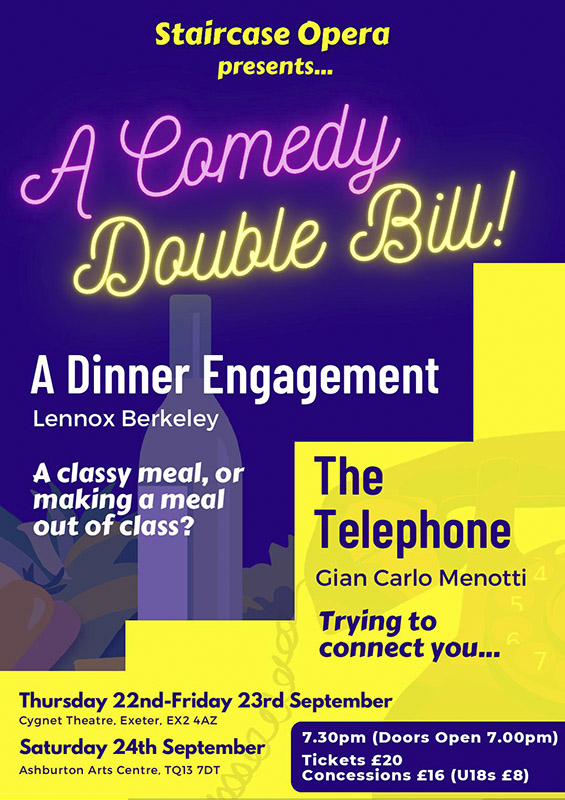
Staircase Opera, a small company of professional players directed by Martin Harvey, will be pairing Berkeley’s A Dinner Engagement with Gian-Carlo Menotti’s The Telephone in a comic double bill in Exeter and Ashburton in September. Known for its highly dramatic productions, Staircase describes A Dinner Engagement as a cross between Upstairs, Downstairs and Front Door Back Door, which pokes fun at class in the 1950s: ‘Who’s coming? Who’s cooking? Who’s paying the bill?’ Menotti wrote The Telephone in 1947 – ‘all about how being stuck on the phone makes us miss what is right in front of us’. The Exeter performances in the Cygnet Theatre are on 22 and 23 September, and the Ashburton performance in Ashburton Arts on the 24th. Tickets from Cygnet Theatre and Ashburton Arts.
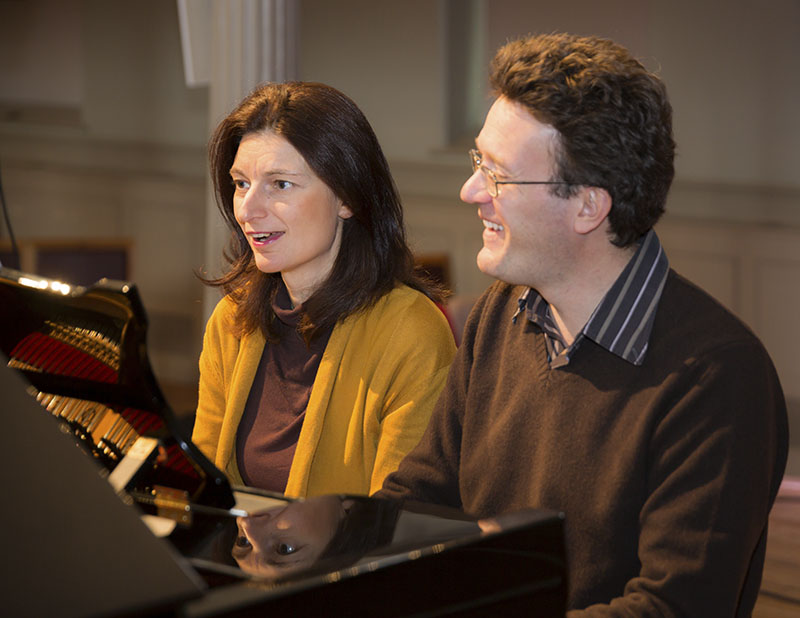
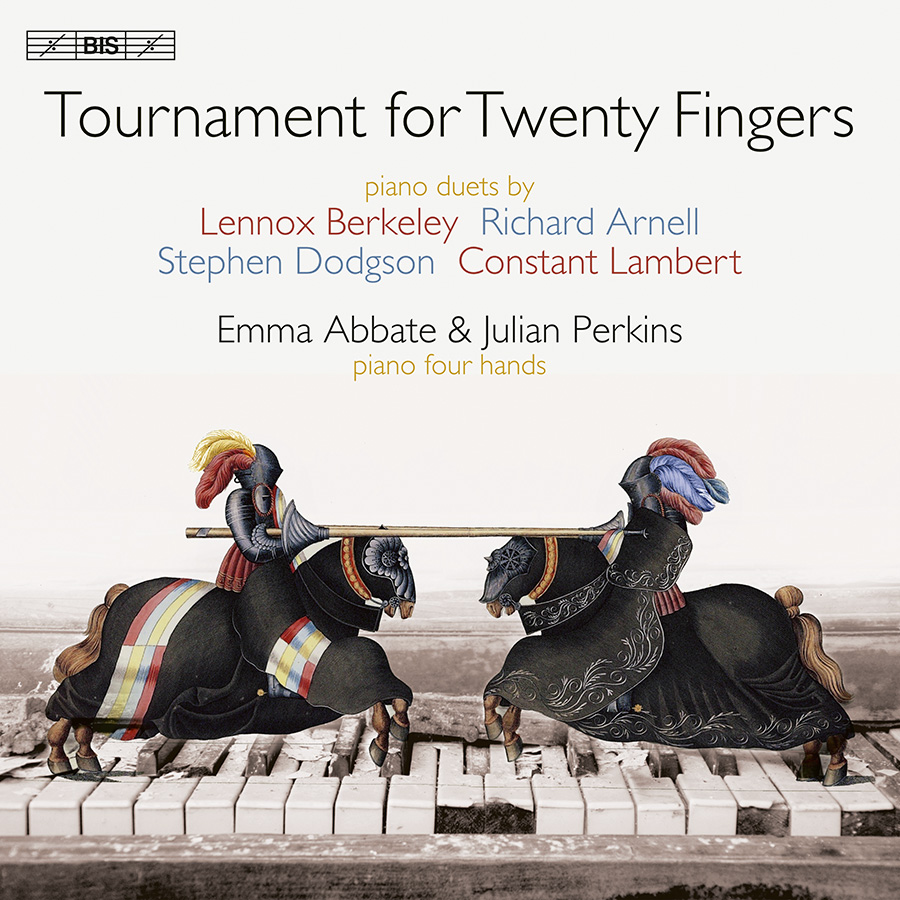
An exciting new CD from BIS brings the complete works for piano duet by Lennox Berkeley in a recording by the husband-and-wife duo, Emma Abbate and Julian Perkins. Supported by the Lennox Berkeley Society, the disc starts with a witty piece that’s sometimes played as an encore, the Palm Court Waltz. This began life as an orchestral work called Diana and Actaeon Waltz, written for Dicky Buckle’s dance extravaganza, Save the Titian, at the London Coliseum in 1971. Berkeley transcribed it for piano duet at the request of Burnet Pavitt, himself a talented amateur pianist, and the two friends often played it together at Berkeley’s house in Little Venice. The composer once described the Palm Court Waltz as ‘not exactly a parody, though rhythms and melodies very close to the Viennese model will be recognised’. He said he had tried to incorporate these elements into his own musical idiom, ‘rather in the manner of Ravel, but not, I feel, nearly so well!’ The other two Berkeley duets are the Sonatina in E Flat, which he wrote for Sir Ashley Clarke, British Ambassador to Italy (who himself gave the first performance with Nini Straneo in the Villa Wolkonsky in Rome in 1959 ), and the Theme and Variations (1968), written for Gerald Stofsky and Annie Alt, who first played it in Stroud in 1971.
The new disc includes works by three of Berkeley’s English contemporaries, Constant Lambert (Trois pièces nègres pour les touches blanches), Richard Arnell, and Stephen Dodgson, whose splendidly-titled collection of eight brilliant duets, Tournament for Twenty Fingers, gives its name – and a wonderful CD cover – to the whole disc.
Of the two pianists, Emma Abbate, accompanist and chamber musician, is a professor at the Guildhall School of Music and Drama, and a staff coach at the Royal Opera House, Covent Garden, and Julian Perkins, keyboard player and conductor, is Artistic Director of Cambridge Handel Opera and Founder Director of Sounds Baroque. The couple made the recording in November 2020, during a relaxation of the Covid lockdown, at St George’s, Brandon Hill, Bristol – whilst simultaneously continuing their own careers, and home-schooling their two six-year-old boys; Julian Perkins will be writing about this juggling act in the 2023 Berkeley Society Journal. Reminding themselves that the piano duet originated as the medium for domestic music-making in England in the nineteenth century, when ‘hands-on concertgoers would explore the symphonic repertoire at home through keyboard arrangements, often in duet form’, they consciously aimed at recapturing an ‘attitude of playful intimacy’. In this way, as Julian puts it, the listener is drawn in to eavesdrop on music-making, rather than listening to a performance projected outwards. Tournament for Twenty Fingers comes on BIS-2578 SACD, available online at the special price of £11.78 until the end of September from Europadisc.
A magnificent choral work by Lennox Berkeley – long forgotten, and only once performed – has been re-discovered by the conductor Michael Waldron and given a world premiere recording on Orchid Classics which comes out on 14 July 2022.
Berkeley wrote his set of seven Variations on a Hymn by Orlando Gibbons for the English Opera Group in 1951, and dedicated it to Dorothy, Dowager Countess of Cranbrook. The work was given its first and only performance by the Aldeburgh Festival Choir and Orchestra, conducted by the composer, with Peter Pears as tenor soloist and the organist Ralph Downes, in Aldeburgh Parish Church on 21 June 1952. In 1981 it was published by Chester’s, but was never performed again, till Michael Waldron found the score last year, realised it was perfect for his London Choral Sinfonia, and recorded it with the tenor Andrew Staples in the Spring of this year. The piece runs for just under twenty minutes, and sounds like this.
Berkeley’s Gibbons Variations are joined on Orchid Classics ORC 101200 by three, more familiar, English works: Vaughan Williams’ Five Mystical Songs (with Roderick Williams as soloist) and Paul Drayton’s arrangement of the same composer’s The Lark Ascending (Elena Urioste, vioin) and Peter Warlock’s Capriole Suite. The disc is available for £12.25 at Presto Music.
Berkeley at the Razumovsky Academy
February 2022
Josipa Bainac
Three young musicians now living in Vienna are bringing to London next month a mixed programme of works by Lennox and Michael Berkeley. The performers are the Croatian mezzo-soprano Josipa Bainac, the Russian viola player Alexander Znamenskiy and the Czech pianist David Hausknecht. The Lennox Berkeley works are the third and sixth of the Piano Preludes, four songs (d’Un vanneur de blé, Lauds, Tant que mes yeux, d’Un fleuve and de Don Juan) and two pieces for viola and piano (Andantino and Duo). Michael Berkeley will introduce one of the ensemble’s four concerts. This one will take place at the Razumovsky Academy (56 College Road, NW10 5ET) on 15 February at 7.30 pm. The concert will open with Marietta’s Song from Korngold’s Die tote Stadt, followed by the Lennox Berkeley pieces, then Britten’s Reflections for piano and viola, two songs by the Hungarian composer and bass Akos Banlaky, and the concert will end with a group of pieces by Michael Berkeley, including Echo: Homage à Francis Poulenc for piano and viola, and Haiku for piano solo. The ensemble is giving three other London concerts: at Bob Boas House, 22 Mansfield Street, WIG 9NR on 11 February; All Saints Church, West Dulwich, on 13 February; and the Austrian Cultural Forum, 28 Rutland Gate, SW7 1PQ, on 17 February. Further details of the Razumovsky concert can be found here.
Berkeley Music-making Returns
October 2021
Emmanuel Bach (Photo Angela Melling)
The Society is pleased to announce two Berkeley dates – one a violin recital, the other a concert of sacred choral works. On 15 November 2021 at 6.30pm the young violinist Emmanuel Bach and his accompanist Jenny Stern launches their new CD album, Lennox in Paris, with a concert in the Princess Alexandra Hall of the Royal Overseas League. Supported by the Lennox Berkeley Society, the album unites all Berkeley’s works for violin, and violin and piano, with music by other composers who were influential in Paris at the time Berkeley was studying with Nadia Boulanger. As a taster Emmanuel’s ROSL recital starts with Berkeley’s Sonatina Op. 17 of 1942, and includes Wienawski’s Fantaisie brillante on themes from Gounod’s ‘Faust’, Lili Boulanger’s D’un matin de printemps and Poulenc’s Sonata for Violin and Piano.
Ten days before that the Joyful Company of Singers (conductor, Peter Broadbent) performs Berkeley’s Mass for Five Voices at a concert called Lux Beata in St Gabriel’s Church, Pimlico, on 4 November at 7pm. The programme includes sacred works by Brahms, Bruckner, John Rutter, Cecilia McDowall and Alexander Campkin, and the pianist Zoe Dixon plays pieces by Brahms and Schubert.
RICHARD STOKER
8 November 1938 – 24 March 2021
Richard Stoker at the unveiling of the Berkeley plaque at 8 Warwick Avenue, London W2, in 2008 (Photo Gill Stoker)
The prolific composer Richard Stoker, pupil of Lennox Berkeley, a founder member of the Berkeley Society, and ardent champion of his teacher's music, died in hospital in London, on 24 March, aged 82. Richard wrote a large number of works for his two favourite instruments, piano and guitar, together with operas, a piano concerto, three string quartets, three piano trios, song cycles, choral works, orchestral works and organ music. He was also an actor, appearing in more than a hundred films, including Pirates of the Caribbean, Dark Shadows and Last Christmas. A man of many parts, he also wrote two novels, three plays, short stories and poetry, and painted. Richard Stoker started playing the piano at six, and was composing at seven. After initial encouragement from Arthur Benjamin and Benjamin Britten, he studied under Lennox Berkeley at the Royal Academy of Music, and under Nadia Boulanger in Paris. He was a professor of composition at the Royal Academy for twenty-six years, a tutor there too, and later became Hon. Treasurer of the Royal Academy of Music Guild. From 1969 to 1980 he edited Composer magazine. In an interview with John France for the MusicWeb International website, Richard said that Lennox Berkeley taught him to be himself, to develop his ideas, to write economically and to analyse the masters. Berkeley, he said, 'was a gentle, relaxed personality, showing incredible empathy'. He also had perfect taste and a remarkable wit, and all these qualities showed in every note of his music. Richard recalled that at the end of their lessons in the Berkeley's house in Warwick Avenue, they would both light up their pipes, and the study would fill with smoke. Lennox's favourite tobaccos were Balkan Sobrani and Four Square. 'When I introduced him to Baby's Bottom, he was in fits of laughter'. Michael Berkeley said that his father was enormously fond of Richard Stoker, and of 'the mix of innocence and curiosity which made both him and his music so idiosyncratic'.
TS
William Wynne Willson's piano music website to be restored
February 2021
One of the least known but most useful musical resources on the internet is a free archive of ready-to-use sheet music of neglected keyboard pieces for viewing, listening and downloading. The archive was curated in 2002 by Dr William Wynne Willson, mathematician, enthusiastic amateur pianist, and founding Webmaster of the Lennox Berkeley Society. But after his death in 2010 some of his music files disappeared, and it is only now, thanks to the efforts of his daughter, the soprano Emma Dogliani, and Thomas Daly, William's successor as Webmaster of the LBS site, that resource has been restored and returned to work online.
Emma, who is a loyal member of the Berkeley Society, is determined that the site should remain available free for everyone, as her father intended, but the cost of the administration, and of typesetting new additions to the archive, is proving daunting, and she has launched a Crowdfunding appeal to help. If you would like to contribute you can do so here.
But be sure, anyway, to visit and use the site at musicwww.co.uk. The 137 pieces of sheet music presently available were all chosen and typeset, sometimes transcribed, by William himself, and Emma has plans to rescue more of the lost files and to add others. The existing archive comprises, in the main, outstanding works by lesser-known composers (for example, the slow movements of sonatas by the English composer Geporge Pinto) or unknown works by better-known composers (for example, a charming Cantabile by Chopin). Necessarily confined to compositions in the public domain, the collection could not include any Berkeley, or any other contemporary works still in copyright.
The pieces range from two preludes and an esquisse by Alkan to Hugo Wolf's only published work, Wiegenlied. There are also three pieces by William himself: two rags and an In Nomine. In between are works by Bach, Fischer, Haydn, Mozart and Schubert and a set of variations by John Field aged 12, and lots more. There are also special collections – of clock music, duets with one easy part etc.
The site is simple to use. You choose your piece on the Full List tab, view it while listening to a synthesiser playback, with the cursor scanning the score simultaneously, and then download to run off on your printer.
William Wynne Willson was a remarkable man, not only a mathematician and computer expert, but also an accomplished keyboard player. He had a special fondness for the music of Berkeley and became an active and influential champion of his music. In an obituary in The Mathematical Gazette in November 2010, his colleague Tony Gardiner wrote of William's enthusiasm which never grew weary. 'He always saw the possibilities rather than the dangers; and in his hands the possibilities were immense and the dangers relatively few.' We in the Berkeley Society can confirm Tony Gardiner's words, that William's 'combination of insight, gentleness, open-mindedness and sheer humanity' were an inspiration and a support to musicians as well as mathematicians.
TS
EITHNE HERBAGE, R. I. P.
December 2020
The Lennox Berkeley Society is very sad to announce the death of one of its founder members, Mrs Eithne Herbage, a Patron of the Society, former composition pupil of Lennox Berkeley and teacher for many years at the Royal Academy of Music. She died in the Acton care home in Gunnersbury Lane, London, on the evening of 19 December, after a long illness, aged 93.
Eithne was a vital member of the Committee of the Society for many years, and it was through her contacts at the Royal Academy, and the esteem in which she was held there, that the Society was able to build the fruitful relationship which led to a series of annual Berkeley concerts there for four years in a row.
Even when she could no longer attend Committee meetings, she retained a deep interest in our activities, through the LBS Journal, and, more directly, through her fellow Committee member, Mrs Sidney Buckland, the Poulenc scholar, who became a valued friend and regular visitor to Eithne's flat in Devonshire Place. Eithne was also an unfailing source of information about Berkeley's music, which she admired unreservedly, and about his family life after the war.
Born on her father's farm at Trearddur Bay on the Isle of Anglesey, Eithne Herbage was the last survivor of seven long-lived siblings, one of them a nun. In 1945 she won a place at the Academy to study piano and composition, and became one of the first pupils of Lennox Berkeley, who had just left the BBC to devote himself full-time to teaching and composing. At first the lessons were at the Academy and then at the Berkeley home in Warwick Avenue. Recalling those years for the Journal in 2010, Eithne said she had never been out of Anglesey before coming to London at the age of eighteen, and entering the world of Lennox and Freda Berkeley was a magical experience which she never forgot.
Eithne was married briefly – to a cousin of the BBC producer Julian Herbage.
Given the current lockdown, the funeral will be a necessarily private affair in Anglesey, but it will be live-streamed for those who would like to watch it; dates to follow. Afterwards the ashes will be laid to rest in the family grave, under a Celtic cross.
HISTORIC RECORDING of a BERKELEY MASTERPIECE
November 2020
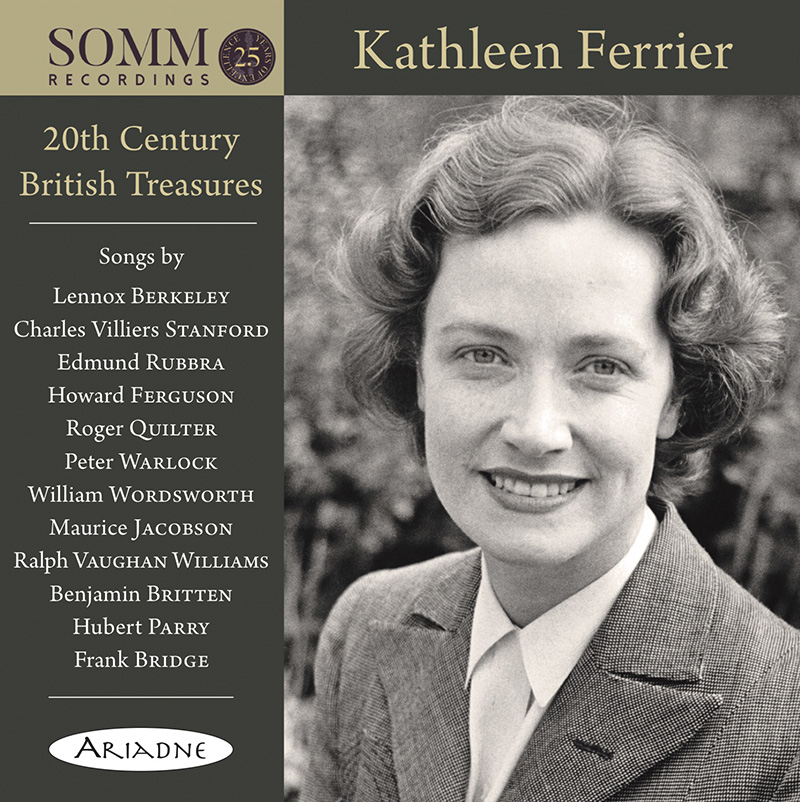
SOMM Recordings are releasing a previously unpublished recording of the legendary contralto Katheen Ferrier singing one of Lennox Berkeley's finest works, the Four Poems of St Teresa of Avila. The orchestra is the LSO with the conductor Hugo Rignold, and the recording comes from a BBC broadcast on April 7 1952, the day after the same forces had performed the work to a well-filled Royal Festival Hall. In his programme note for SOMM, Sir Thomas Allen, a Trustee of the Kathleen Ferrier Awards, points out that the work provides yet another example of the conviction of Ferrier's faith, 'such is the passionate commitment of her attack'. This, he writes, is 'quite shattering for us, her audience. One is aware of a laser-like intensity, never losing sight at any time of the task that lies before her in delivering her message.' Berkeley wrote the St. Teresa Poems especially for Kathleen Ferrier, after hearing her sing Britten's Lucretia at Glyndebourne in 1946, and it was she who gave the first performance with the Goldsbrough String Orchestra conducted by Arnold Goldsbrough in the Concert Hall of Broadcasting House on 14 April 1948. The new CD, Kathleen Ferrier 20th Century British Treasures, includes works by Stanford, Rubbra, Ferguson, Wordsworth and Jacobson and shorter works by Parry, Quilter, Vaughan Williams, Bridge, Warlock, and Britten. Full details of the new CD, and how to buy it, can be found here.
KATHLEEN WALKER, R.I.P.
9 October 2020
The Lennox Berkeley Society is sad to announce the death of Mrs Kathleen Walker, co-Founder and Patron. Kathleen died after a fall at her home in Overstrand, near Cromer, Norfolk, on Tuesday morning, aged 97. A retired legal secretary, she had been living alone since the death of her husband, Pat, in 1984. Kathleen devoted the last two decades of her life to the promotion of Berkeley’s music, first as a valuable Committee member, and then – in a role she created for herself – as the Society’s periscope, scanning the internet horizons for new recordings and performances of Berkeley’s compositions.
Keenly musical, Kathleen was first drawn to Berkeley's work when she heard the orchestral Divertimentoon Radio Three in the mid-1980s. Still newly widowed, she found the melancholy second movement, 'Nocturne', particularly affecting, and sought out more Berkeley, starting with Christopher Headington's recording of some of the piano music. She then joined the British Music Society and, encouraged by the musicologist Dr Brian Trowell (formerly Heather Professor of Music at Oxford, and a leading light in the BMS), she decided to start a society to spread the word about Berkeley's music.
A notice in the BMS Newsletter brought a response from another enthusiast, Jim Nicol, and together the two formed The Lennox Berkeley Society. Approaching the Berkeley family for the first time, they invited Lady (Freda) Berkeley to become the founder Patron. Freda set to work recruiting members from her wide circle of friends, and on 9 December 2000 she hosted the Society's inaugural meeting in her flat in Bayswater. Sir John Manduell agreed to serve as founder President, and the young organist William Whitehead was elected founder Chairman.
That this small society should have achieved so much in twenty-one years is a tribute to the vision and dedication of Kathleen Walker – and of Jim Nicol (who died in January last year). Kathleen will be acutely missed for the example and inspiration of her selflessness, keen wit and the warmth of her interest in the Society's affairs. A full Obituary will appear in the Society's 2021 Journal.
TS
Photo: Mrs Kathleen Walker, at the Gunton Arms, Thorpe Market, Norfolk, in July 2019, on an outing with her devoted friends, Society members Tay Cheng-Jim and Neil Williamson (Photo Tay Cheng-Jim).
Songs for Sir John
October 2020
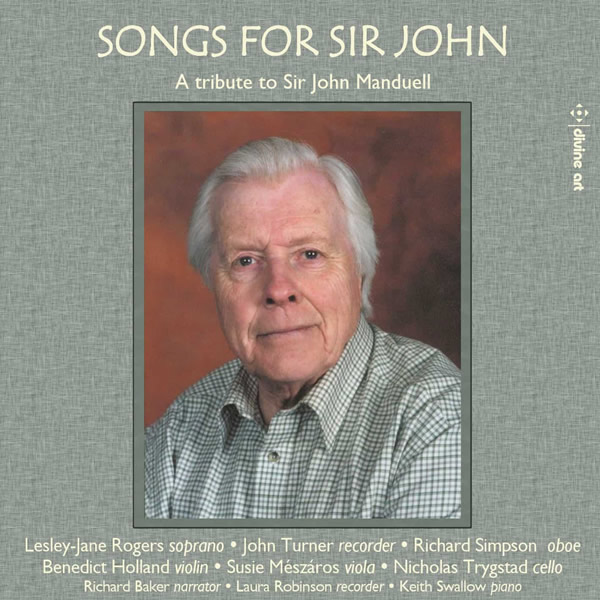
The recorder player John Turner and other friends and associates of the late Sir John Manduell (composer, music administrator and founding President of the Lennox Berkeley Society) have produced a fine CD album in his memory. It’s called Songs for Sir John, and it comprises sixteen works by sixteen contemporary composers who have in some way found their professional careers guided and encouraged by Sir John's enthusiasm and support. The disc offers the world premiere recording of Berkeley’s set of three short duets for two recorders, played by John Turner and Laura Robinson. The same artists gave the first performance of these early pieces in Aldeburgh last autumn, and were to have played them again for our AGM this Spring, until the pandemic forced the postponement of the event. The set begins with ‘Moderato’ of 1938 and the recently-discovered ‘Minuet’ of 1924, which Berkeley wrote while he was an undergraduate at Oxford, and it ends with ‘Allegro’, completed in 1955. The first two have never been published independently, the last was published in 1955 in a version edited by Britten. All three will soon be published together by Boosey and Hawkes, in an edition by Michael Berkeley with ‘the expert guidance of John Turner.’ In a review on MusicWeb International John France describes the set as ‘a charming addition to both the recorder repertoire and Lennox Berkeley’s catalogue’. Also included on this new disc are pieces by two composers much influenced by Berkeley, Peter Dickinson (author of the definitive musical biography of the composer) and Sally Beamish, both Patrons of the Society. Songs for SirJohn ‘is an album to savour,’ writes John France. ‘There is nothing here that is overtly challenging, but much that is beautiful.’ The disc is available on the Divine Art Records label.
The long-delayed new release of Berkeley's opera Nelson, in the concert performance broadcast by BBC Radio Three in 1988, was due for release on the Nimbus label this autumn but has had to be postponed till 2021, as a result of the pandemic. In a development which will be welcomed by the Society and all lovers of Berkeley's music, the Nelson CD will come out with transcriptions of broadcast performances of his three other completed operas, all recorded off transmission by the enterprising founder of Lyrita Records, Richard Itter.
Lennox Berkeley Society Lockdown News
June 2020
Despite the restrictions the Society is able to report a number of developments:
Berkeley Family Papers
The Berkeley Family Papers have been acquired by Britten Pears Arts (the name of the newly-merged Britten-Pears Foundation and Snape Maltings). This outstanding collection provides important sources for the study of the life and work of Lennox Berkeley, and the BPA is compiling a full and detailed catalogue of the archive, which will be made available to researchers both on site at the Red House and online at the Britten Pears Library website.
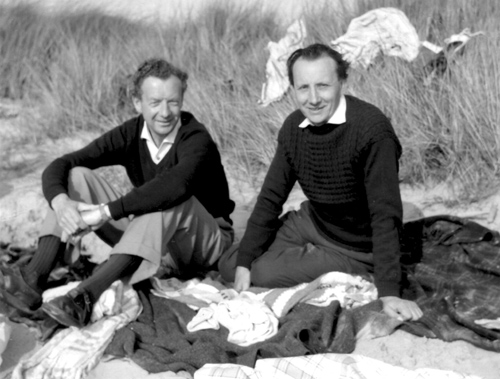
Right: Lennox Berkeley and Benjamin Britten, Blakeney Point, 1961
Berkeley's Legacie
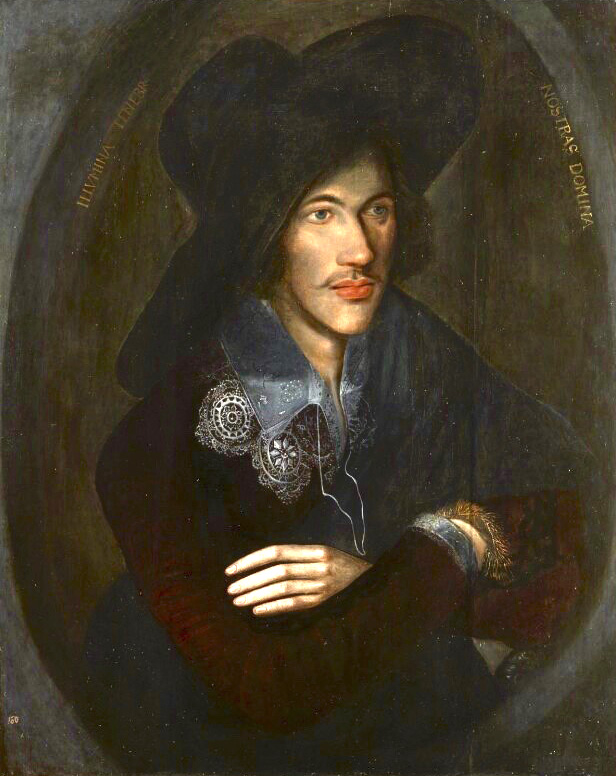
Chester Music are planning to publish a neglected choral work by Berkeley called Legacie, a setting for mixed voices of a poem by John Donne (pictured left) dealing with the confusions of love and parting. It will join Berkeley's other English choral settings, such as Spring at This Hour, There Was Neither Grass Nor Corn and The Midnight Murk. Legacie dates from 1943 when Berkeley was working for the BBC, and it may have been written for Fr McElligott's Wireless Singers who performed Berkeley's incidental music for a BBC drama called Yesterday and Today in April that year. The composer was feeling particularly isolated and vulnerable at this time because his new young friend, Peter Fraser, was away in Iceland with the RAF, and his thoughts may have been turning back to his previous relationship with Benjamin Britten (who was celebrating his 30th birthday that year). Matthew Berry, Choral Promotion Manager of Chester Music – and joint founder of the chamber choir Commotio which has sung so much Berkeley – found the work in the British Library. James Welland, Managing Editor of Chester Music, will oversee Legacie into print.
Chester Music's New Website
Chester Music have designed a new website which incorporates revised entries for all its composers, including Berkeley. Thomas le Brocq, Creative Manager (Back Catalogue and Opera), is hoping to incorporate articles from back numbers of the Lennox Berkeley Society Journal. The new Berkeley pages, which are still under development, can be seen here.
Boosey and Hawkes publish set of recorder pieces
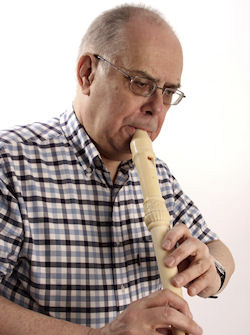
Boosey and Hawkes have confirmed that that they will be publishing, as reported in the 2020 Berkeley Society Journal, the set of three Berkeley recorder pieces edited by John Turner (left) and Michael Berkeley. It is hoped they will come out at the same time as the release of John Turner's new CD which includes the first recorded performance of the set. The three pieces, all for a pair of treble recorders, were written at different times in Berkeley's life: Moderato (1938), Minuet (c.1924, discovered only last year), and Allegro (1938). Allegro was published by Boosey's in 1955, in a version edited by Britten, but the other two pieces have never been published before. The three pieces could be played by any two treble wind instruments, such as flutes or flute and oboe.
Songs for Sir John
John Turner's new CD, Songs for Sir John, is a tribute to his friend and associate, the composer and music administrator Sir John Manduell (the Society's first President, pictured right). It includes works by contemporary composers who have in some way found their professional careers guided and encouraged by Sir John's enthusiasm and support. They include two composers much influenced by Lennox Berkeley, Peter Dickinson (author of the definitive musical biography of the composer) and Sally Beamish. The CD will come out on the Divine Art Records label later this year.
Lennox Berkeley Society AGM and Annual Concert
The Society's AGM and annual concert which were to have been held in London in May have been postponed till after the general release from the Covid 19 lockdown. The recorder players John Turner and Laura Robinson and pianist Nathan Williamson have kindly signalled their readiness to play the Berkeley recorder set and the rest of their projected concert programme as soon as a new date can be rescheduled.
In the Stars
Members of the Society might be interested to know that there is a horoscope of Lennox Berkeley online (at star4cast.com), but it is concerned less with his music than with his emotional life. Compiled by the astrologer Marjorie Orr, it describes his marriage to Freda Bernstein as 'an impossible match that worked'. Lennox (born on 12 May 1903), was in the jargon of astromancy, 'a Sun Taurus with his Venus in Gemini conjunct Freda's Mars; and his Jupiter in Pisces conjunct her Uranus'. And Freda (born 25 May 1923) was 'an airy Sun Mercury in Gemini trine Saturn in Libra, sextile musical Neptune in Leo' with a 'steadfast and charming Venus in Taurus sextile Pluto and opposition Jupiter'. Since Freda also had 'a wide Yod of Saturn sextile Neptune in conjunct Uranus', Miss Orr maintains that she would have flourished in an unconventional setting. So, her reading concludes, there was 'a spark of passion and a sense of adventure between them'.
New recordings of Elegy and Toccata for violin and piano
May 2020
SOMM Recordings has released a tribute to the flourishing of British violin sonatas in the 20th century. This CD includes Lennox Berkeley's Elegy (Op.33 No.2) and Toccata (Op.33 No.3, for Frederick Grinke) and other music for violin and piano by key figures of the modern chamber music renaissance in Britain. Making her debut on SOMM, violinist Clare Howick's championing of this repertoire prompted iclassical to declare "the record-buying public owe [her] a debt of gratitude". She is accompanied by pianist Simon Callaghan.
Harmoniemusik Presents Berkeley
December 2019
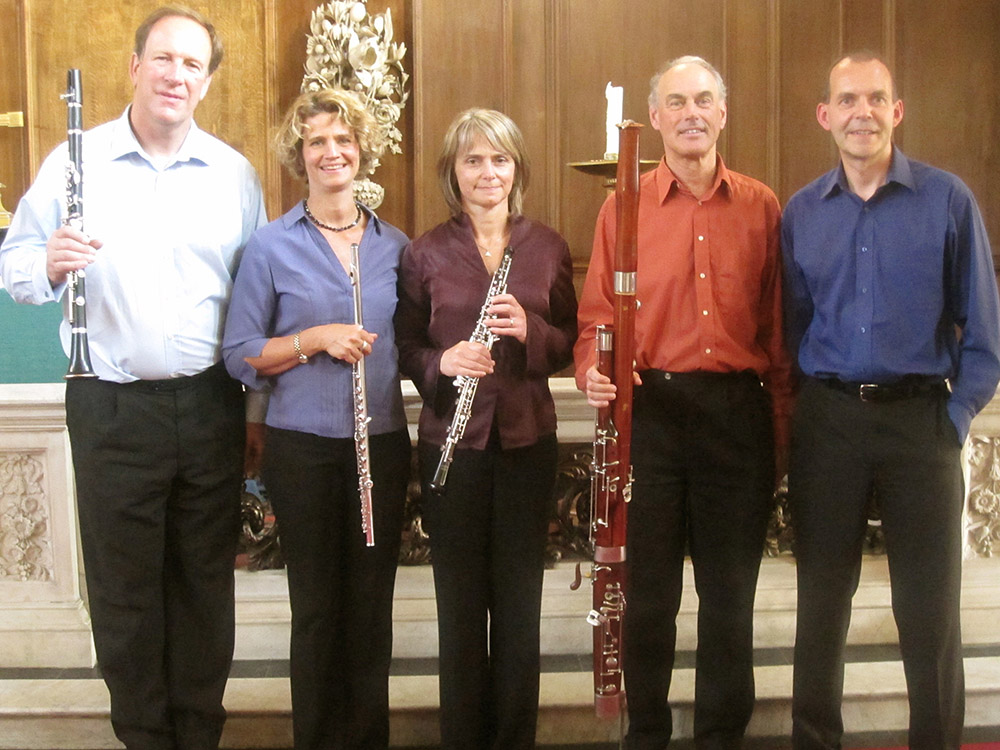
The chamber group Harmoniemusik, of which Berkeley Society member Paul Guinery is pianist and occasional arranger, has programmed the Berkeley Flute Sonatina for a concert at the Letchworth Music Club on 12 February. The core players of the group, with Paul, are the flautist Janna Hüneke, Sarah Devonald playing oboe and recorder, the clarinettist Mark Lacey, and Alec Forshaw playing bassoon and harpsichord. Variety has always been a hallmark of their music-making and the Letchworth concert will be no exception. The programme opens with Poulenc's Trio for Oboe, Bassoon and Piano, dating from 1926 – the year he first met Berkeley (then just starting his long period of study with Nadia Boulanger in Paris). Then comes Berkeley's Sonatina, followed by Nino Rota's Trio for Clarinet, Bassoon and Piano. In the second part: a chorale and aria by Bach, three songs by Gershwin arranged for wind quartet, the first movement of André Caplet's Quintet for Piano and Wind, and finally a potpourri from Sullivan's Savoy Operas arranged by Paul Guinery. Harmoniemusik believes in bringing alive a spirit of communication at all its concerts, so each member in turn will introduce the various pieces. The concert will take place at Howgills, the Society of Friends Meeting House, 42 South View, Letchworth Garden City SG6 3JJ, on 12 February 2020. It starts at 7.45, and tickets can be bought at the door.
The chamber group Harmoniemusik
Two Berkeley Premieres In The Red House
October 2019
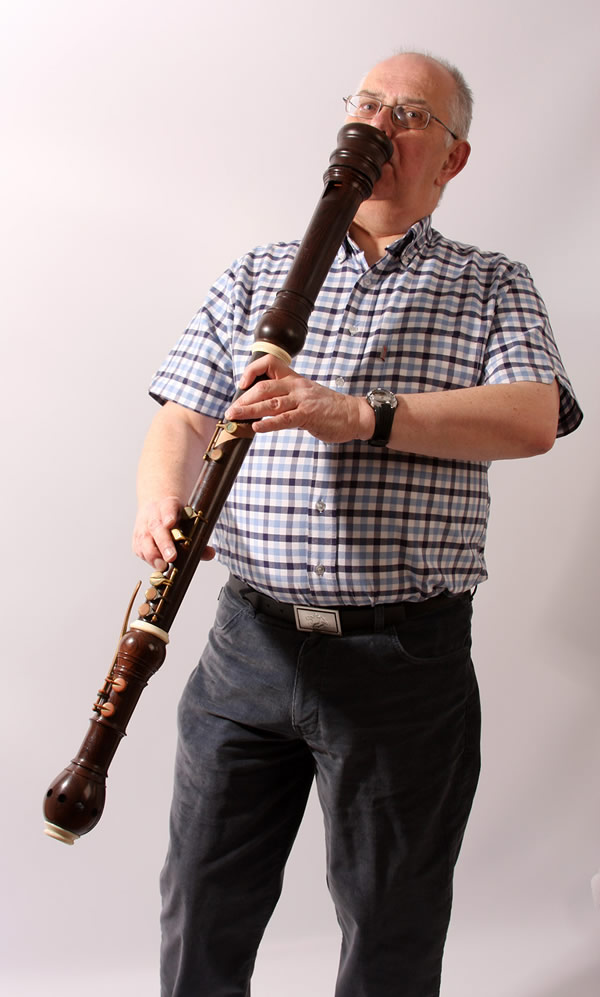
John Turner playing a bass recorder
Two unpublished instrumental works by Lennox Berkeley were given their first public performance at the Alwyn Music Festival in Benjamin Britten's Red House at Aldeburgh on the evening of 9 October. Both are short duets for two treble recorders – one dating from Berkeley's undergraduate years at Oxford, the other from 1938 – and both were written for the composer to play with his godmother, Sybil Jackson. Next month's professional premiere will be given by the recorderists John Turner and Laura Robinson. Turner began his extraordinary musical life as a flute student at the Northern School of Music and a law student at Cambridge, then as a solicitor acting for musicians, and finally as a professional musician. He had known many musicians at Cambridge – among them Christopher Hogwood, John Eliot Gardiner, and David Munrow who launched his career as an instrumentalist in the pioneering Early Music Consort of London. Since then John Turner has commissioned and inspired hundreds of new works, as well as unearthing, editing and publishing many more scores which might otherwise have been lost to posterity, including a sonata by Handel, which he will play at the Red House. He will also be playing works written specially for him by Peter Dickinson and Elis Pekhonen, and a range of other twentieth-century and contemporary music; and the pianist Nathan Williamson played pieces by William Alwyn and Michael Berkeley. See here for further details.
Two Dinners
May 2019
Exciting new productions of Lennox Berkeley's one-act comic opera A Dinner Engagement took place in summer 2019. Both are student productions – one in London, the other in Amsterdam – and both will be staged in imaginative new pairings. At the Royal College of Music, the Opera School presented the Berkeley piece with Leonard Bernstein's dark one-acter Trouble in Tahiti, a candid portrait of the troubled marriage of a young couple in American suburbia. At the Conservatorium of Amsterdam, the Dutch National Opera Academy performed the Berkeley with Judith Weir's tense psychodrama, Blond Eckbert, about power, passion and redemption through love. The RCM performances took place in the Britten Theatre on 26, 28 and 29 June and 1 July. Tickets available here. The Dutch double bill took take place on 29 and 30 June and 2 and 3 July. Tickets are available here.
Conversations with Sir John Manduell
May 2019
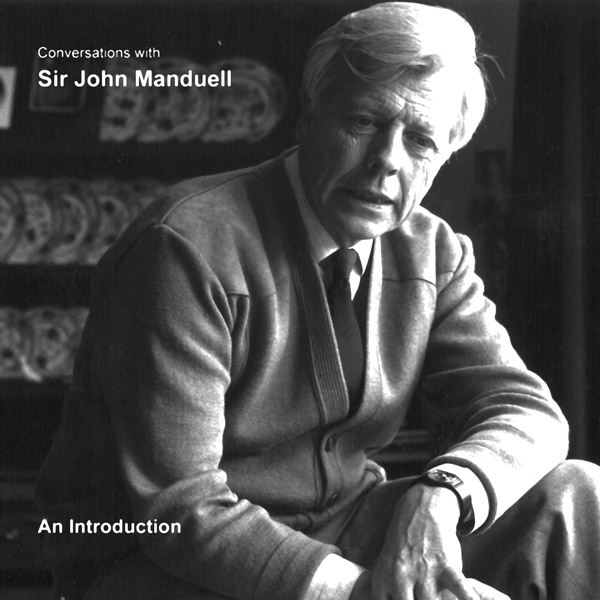
The record label Prima Facie has produced a remarkably comprehensive tribute to the late Sir John Manduell, composer, music administrator and founding president of the Lennox Berkeley Society. It takes the form of a beautifully-presented box set of six CDs – five containing conversations with Sir John, and the last one containing recordings of some of Sir John's works. The conversations are with Michael Berkeley, the recorder player John Turner, the conductor and organist Sir Philip Ledger, the late Christopher Yates, formerly Vice Principal of the Royal Northern College of Music, and the arts administrator, conductor and trumpeter Gavin Henderson. In a vivid and spontaneous conversation with Michael Berkeley, Sir John recalls his composition studies with Sir Lennox, the ambience of the Berkeley household at 8 Warwick Avenue, London W. 2, and his years as programme director of the Cheltenham Festival, when Berkeley was president. In an introductory note, John Turner explains that the project took shape in 2005 when Sir John became too ill to compose. Friends suggested that he should write an autobiography but he decided to record some memories in audio form instead. Many but not all of the stories in these recordings re-appeared in the autobiography which Sir John did eventually publish, No Bartok Before Breakfast. 'Listeners', writes John Tuner, 'will enjoy in these discs Sir John's inimitable voice and his wily humour, and wonder at the amazing variety of ways in which music in Britain and Europe was nourished and energised by his magnetic personality.' The set is available at a cost of £20 on Prima Facie PFSWCD001-6. To find out more, and to place an order, members should visit the Prima Facie website.
Berkeley Day at Merton College Oxford
2 March 2019
To celebrate Berkeley's four years as an undergraduate at Merton (1922-6), and to mark the
30th anniversary of his death, Benjamin Nicholas (Director of Music at the College), Petroc
Trelawny (President, LBS), and Julian Berkeley arranged a Berkeley Day that took place on Saturday 2 March 2019. For full details, please download our programme.
Lennox Berkeley Society Award for Guitar 2017
January 2017
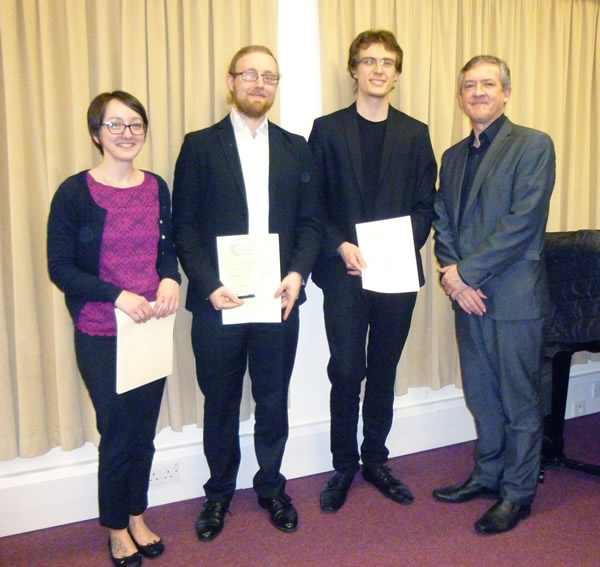
Emma Smith (left), Ioannis Theodoridis, Emmanuel Sowicz and Gary Ryan (right)
The class for the seventh Award for Guitar was held at Headington School, Oxford on January 29. Three guitarists took part: Ioannis Theodoridis, Emma Smith and Emmanuel Sowicz.
Ioannis played first, and began with Michael Berkeley's beautiful little Impromptu. This was given a sensitive, nuanced account with good melodic line and balance of the outer voices. There followed Lennox's Theme and Variations, Op. 77. The music was well-shaped and the variations effectively constructed: a performance showing precision and elegance, and the epilogue just right.
Emma played next, performing the Sonatina Op. 52. Her playing was well-articulated with good clear tone. In the first movement, the subjects were considerately beated. The Lento was well-shaped with some delicate touches, and her pizzicato technique was subtle. The Rondo theme of the last movement was well-expressed, and Emma showed an excellent tremolo technique. The expressive melodic episode was slower than usual, but effective for that choice. All in all an individual, interesting version of a work that is probably the most difficult of the solo guitar works by Lennox Berkeley.
Emmanuel Sowicz performed the Quatre Pièces of 1927 or 1928. He played very well, giving to each movement a strong sense of purpose, and a feeling of coherence to the whole work. Particular assets were strong sense of rhythm, wide dynamic range and beautiful tone. The Sarabande was an expressive highlight. Hearing the pieces on this occasion really showed how well Lennox wrote for the guitar even at the beginning of his career.
The guitarists were glad to receive the comments of Gary Ryan, whose adjudication combined expertise and encouragement. The award went to Ioannis, but Gary felt that each of the players were worthy of it.
This class was a particular pleasure in that all of Lennox's solo guitar music was presented.
Christopher Daly
A Berkeley First
October 2018
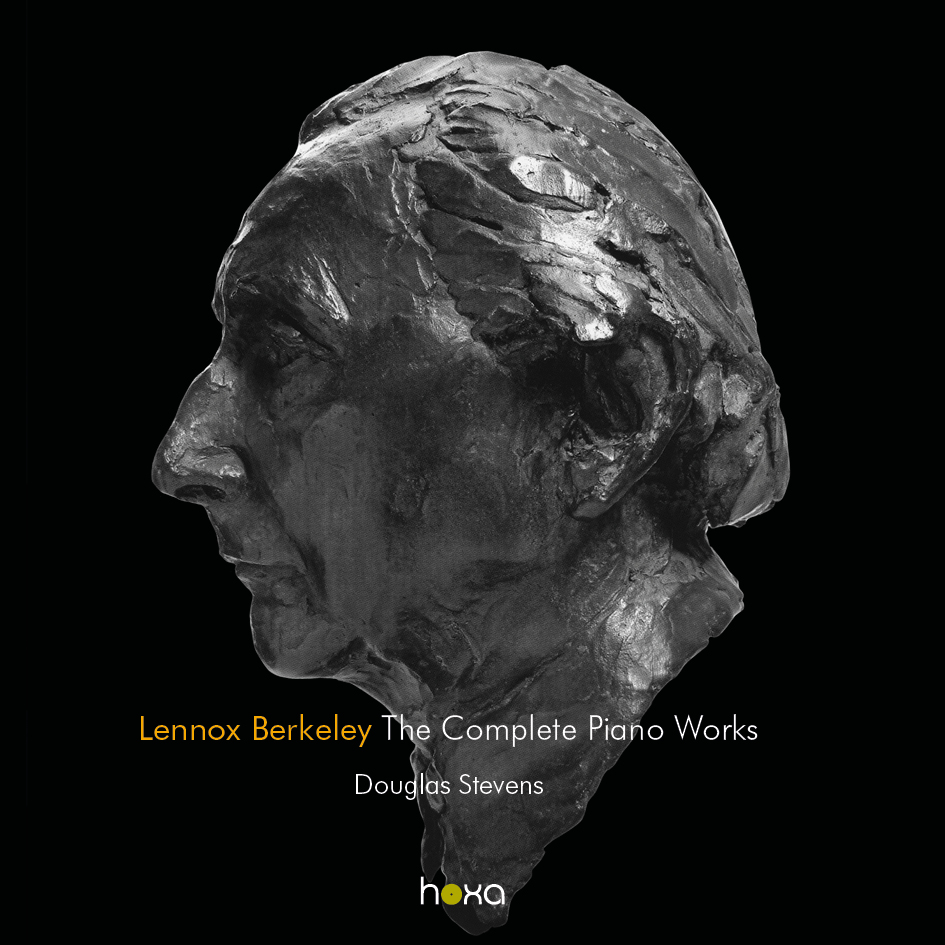
The only complete recording of all Berkeley's piano music has just come out on two brilliant new discs under the Hoxa label. It's a magnificent collection of forty-seven separate pieces — from the March which Berkeley wrote for his friend, Vere Pilkington, in 1924 (when both were undergraduates at Oxford), to the Mazurka Op. 101 no. 2, written for the 250th anniversary of the birth of Haydn in 1982. The pianist is the Berkeley scholar, organist and composer, Douglas Stevens, whose doctoral thesis at the University of Bristol focused on the music of Berkeley. Stevens proves to be a sensitive and polished interpreter, with a virtuoso technique that makes light of some fiendishly difficult music. He plays the tumbling runs of the Four Concert Studies, for example, with a bravura that all but takes the breath away. Berkeley wrote these studies in 1940, and admitted to his friend Benjamin Britten that he himself could not play a bar of any of them. Stevens is no less compelling in the more reflective pieces, bringing to the Paysage of 1944 a sad tenderness that evokes the composer's deep feelings for France. In a review for the British Music Society, Alan Cooper writes that Hoxa's two CDs 'are a marvellous introduction to Berkeley's piano music presented by an artist thoroughly at home with this music'. In a review for the forthcoming issue of the Lennox Berkeley Society Journal, the Berkeley scholar and pianist, Professor Peter Dickinson, writes of Stevens's 'phenomenal technique' and 'dazzling finger-work'. This is an essential recording for anyone interested in exploring Berkeley's prolific and varied output for the piano. Lennox Berkeley: The Complete Piano Works (Hoxa HS1806-18) is available through Amazon as a double CD, or a download.
TS
Berkeley Rarities at the Wigmore
September 2018
The baritone Benjamin Appl and the pianist Graham Johnson will be including some rarely-heard Berkeley songs in their evening recital at the Wigmore Hall in London on Thursday 11 October. The programme explores the continuing impact of the ancient culture of Greece, charting a course between gods and mythology, philosophy and love poetry. Beginning and ending with Schubert, the anthology also includes songs by Fauré, Duparc, Debussy and Britten. The Berkeley songs are from the set of Three Greek Songs which he wrote in 1951. The first is 'To Aster' (setting a text by Plato) and the second is 'Spring Song' (Antipater). Tickets are available here.
Baritone Benjamin Appl (left) and the pianist Graham Johnson (right)
The late Sir John Manduell, C.B.E.
November 2017
The composer and music administrator Sir John Manduell, who died on 25 October, was not only a leading figure in British music for nearly sixty years, but the founding president of the Lennox Berkeley Society, and one of Berkeley’s most effective advocates. Born in Johannesburg he studied at Jesus College, Cambridge, the University of Strasbourg, and the Royal Academy of Music, where his composition teacher was Lennox Berkeley. After joining the BBC as a music producer in 1956 John Manduell went on to plan the new Music Programme which replaced the old Third Programme (and would soon become Radio Three).
Sir John Manduell's 2016 Memoir
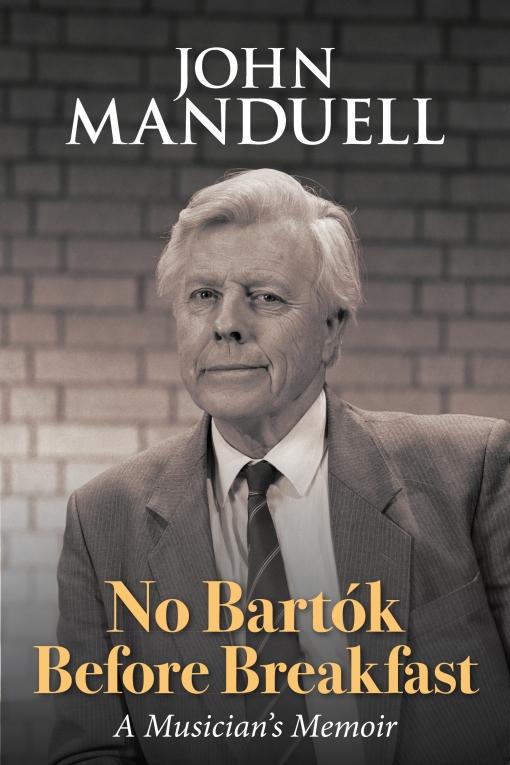
The BBC’s intention was that the new service should be ‘kept firmly in the “middlebrow” range’ – hence an instruction from the Controller of the Home Service, ‘No Bartók before breakfast’ (a telling tag which Manduell borrowed as the title of his book of memoirs published by Arc last year). On leaving the Corporation in 1968 he became the first Director of Music at the University of Lancaster and, in 1971, the first Principal of the new Royal Northern College of Music, where he remained until his retirement in 1996. For a full quarter of a century, from 1969, Sir John was also Programme Director of the Cheltenham Festival, during which time he commissioned no fewer than 250 new works. For the last six of his Cheltenham years, Lennox Berkeley served as President of the festival, and in 1983 Manduell celebrated his old mentor’s eightieth birthday by inviting fifteen former pupils to write a variation of not more than one minute each on a theme from ‘The Reaper’s Chorus’ in Berkeley’s opera, Ruth. Manduell himself edited the contributions into a cohesive whole and added his own introduction to what he called Bouquet for Lennox. Throughout those Cheltenham years Berkeley’s music was constantly featured at the festival, whilst Manduell’s own work was more often heard at the Cardiff Festival. And when Manduell retired from Cheltenham, it was Lennox’s son, Michael, who succeeded him. In a letter of condolence to Sir John’s widow (the pianist and teacher, Renna Kellaway), our President, Petroc Trelawny, and Chairman, Adam Pounds, wrote that without Sir John’s support and enthusiasm the Berkeley Society could not have grown into the ‘vigorous, passionate organisation’ that it is today. ‘From the start he encouraged us to be ambitious and broad-thinking in our efforts to promote the musical legacy of his teacher. Many of the grander projects we took on - our disc of Lennox’s songs, the partnership with the Royal Academy of Music, and last year’s Stabat Mater tour and CD - were a direct result of his determination that we should set ourselves high goals.’ In an affectionate memoir of his time as a student of Berkeley, Sir John told readers of the Society’s 2012 Journal that he regarded his teacher at that time as holding ‘a near-divine pre-eminence’. Berkeley was, he wrote, ‘one of this country’s most admired and distinctive composers.’ It would surely have pleased Sir John that Lennox and Freda Berkeley thought just as highly of him, both professionally and personally. TS
Roy Teed (1928-2017)
November 2017
The life and work of our distinguished old friend, the composer, teacher and accompanist Roy Teed – a founder member of the Lennox Berkeley Society – who died in Colchester on 17 June, aged 89, are to be celebrated by the Colchester Symphony Orchestra at a concert this coming spring. After national service with the RAF, Roy studied composition with Lennox Berkeley at the Royal Academy of Music. He greatly admired his teacher, whose Christian name he gave to his own son, Paul Lennox, and he remained close to Lennox and Freda for the rest of their lives. Members of the Society will remember Roy’s warm and appreciative presence at annual meetings, which he always marked by presenting a bouquet to Freda Berkeley. After leaving the Academy he returned to teach there, and later at the Colchester Institute School of Music, where, some thirty years ago, he established the annual Roy Teed competition for student composers. For many years he accompanied the baritone Norman Tattersall in a duo partnership which gave concerts all over the UK and on Radio Three. In the early 1950s he and Tattersall and the composer Francis Routh founded the Redcliffe Concerts of British Music. Roy was also involved in the early days of Colchester New Music, and served as president – and cheerleader - of the Colchester Symphony Orchestra. His prolific output as a composer ranged from songs (often written for Norman Tattersall, and setting texts by their mutual friend James Kirkup), and choral works to an opera (The Overcoat), concertos for piano and recorder, and chamber works. The Roy Teed Memorial Concert will be given by the Colchester Symphony Orchestra in St Botolph’s Church, Colchester, at 7.30pm on 21st April 2018, a few days before what would have been his ninetieth birthday. The programme will include Roy Teed’s own Phantasy for Flute and Strings, the Brahms Double Concerto for Violin and Cello and the Symphony No 7 by Sibelius. Ticket information can be found on the Colchester SO website.
Roy Teed with (left to right) daughter Lucy, wife Jennifer and daughter Trudy, Colchester Buddhist Centre, 2015
Berkeley with a punch
18 August 2017
Lennox Berkeley in 1960 (photo BBC)
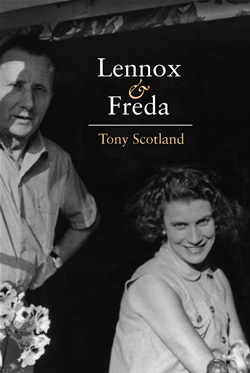
The Society’s current trawl of Berkeley performances on YouTube has yielded a delightful discovery: the Overture in B Flat, performed by Marcus Dods and the Ulster Orchestra, and recorded off-air from the 1980s Radio 3 series Matinée Musicale. An essay on this work by John France can be found on his British Music Blog – Lennox Berkeley: Overture in B flat (1959) Part I, and Lennox Berkeley: Overture in B flat (1959) Part II. Scored for full symphony orchestra, it makes for an exciting curtain-raiser, with lively alternating solo motifs for all sections, engaging melodic lines and driving rhythmic energy, packing a hugely invigorating punch - all in just six minutes. Berkeley wrote three orchestralOvertures. As Tony Scotland records in his Lennox and Freda, the first was started at his flat in Paris in the autumn of 1934. In January 1935 he learned that it had been chosen ‘to represent English modernism’ at the International Society of Contemporary Music Society festival at Carlsbad in Czechoslavia in September. After attending the première there, Berkeley travelled to London the following month to conduct the BBC Symphony Orchestrain the work’s British premiere at the Proms. It was not a success, but the ISCM’s selection board – including the English conductor and champion of new music, Edward Clark, and the German conductor Hermann Scherchen – rated the work sufficiently highly to programme a second appearance at the next ISCM Festival in Barcelona in May 1936. In Berkeley’s view, the Madrid Symphony Orchestra gave ‘a brilliant performance’ there, and The Times critic Peter Burra agreed: the new Overture, he wrote, was ‘delightfully written, with some dazzling orchestration’. Berkeley’s publishers, J. & W. Chester, recognised what they called ‘lines of genius’ in the writing, and ramped up their promotional campaign on his behalf. However Berkeley later withdrew this first Overture.Writing in his diary in the 1970s, he said, ‘[My contribution to the Barcelona Festival] was an Overture that I came to dislike, and later suppressed. I can’t remember a note of it today.’At the end of the war he composed a second orchestral Overture. ‘It’s very light and rather gay,’ he wrote to his wife, Freda – ‘in complete contrast to the Nocturne’. He wrote it for the conductor Anthony Bernard (who had been an early champion of his music) and Bernard’s chamber orchestra, but shortly after its first performance, in Canterbury Cathedral in June 1947, Berkeley disowned this second Overturetoo.The YouTube Overture is a third piece which Berkeley wrote for the BBC Light Music Festival in 1959, when it was played by the BBC Concert Orchestra conducted by Vilem Tausky. Chester’s publish all three Berkeley Overtures. JLB
Berkeley’s Old School Remembers Him
8 August 2017
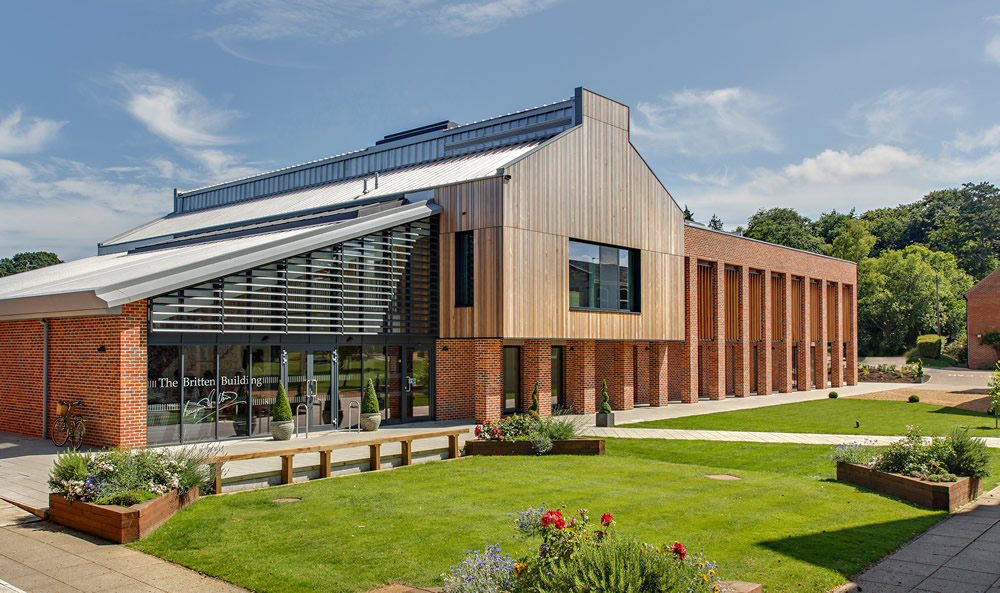
Gresham’s School, Holt, in Norfolk – alma mater of Benjamin Britten, W. H. Auden, Stephen Spender and, before all of them, our own Lennox Berkeley – has built a spectacular new music school. Officially opening the new development on 1 July, the Princess Royal named it The Britten Building, in memory of the composer who was a pupil there from 1928 to 1930. Julian Berkeley, second son of Sir Lennox, visited the Britten Building later in July at the invitation of the new Director of Music, John Bowley, and reported enthusiastically that it offers every conceivable facility for music teaching, with modern and comfortable practice, seminar and teaching rooms; a 140-seat auditorium; Steinway pianos; a sophisticated recording studio; and even a café. The building is the culmination of a multi-million pound, five-year project to improve the musical provision at Gresham’s, and is the most significant addition to the school in twenty years. The intention is to make it available not only to the boys and girls of Gresham’s but to music groups throughout North Norfolk. 'Music is the soul of Gresham’s’, the headmaster, Douglas Robb, said at the opening ceremony, 'and the school has a much-celebrated musical history and an exciting future.’ Mr Robb hoped the new building would allow the school 'to nurture those with a musical talent, and help make a lasting difference to our community for many years to come’. Lennox Berkeley was a pupil at Gresham’s throughout the years of the First World War. Through no fault of the school’s he was not happy away from home. When his parents brought him back to Oxford at the age of only fifteen, he left behind at Gresham’s a reputation for charm and kindness, fluent French and a ‘flamboyant’ style at the piano. For its part the school’s legendary Director of Music, Walter Greatorex, nurtured Lennox’s budding talent for music, and introduced him to hymns and to Plainsong (which was later to influence not only his music but also his faith). The school also introduced Lennox to a part of England he never forgot. Attracted by the wild beauty of the North Norfolk coast and its flora and fauna, he and his wife Freda bought a holiday home in the village of Morston half a century later, and the family still has strong connections – and a sailing boat – there today. To commemorate Berkeley’s years at Gresham’s, the music department has decided to name one of the seminar suites in the new music school the Sir Lennox Berkeley Room. As a former freelance tenor familiar with the music of Berkeley, John Bowley is eager to forge links not only with the family but with the Berkeley Society and the Berkeley Ensemble; and he and Julian discussed the possibility of various exciting collaborations including concerts and Study Days in the grand new music school. TS
Lennox Berkeley Society launches on social media
3 August 2017
Thanks to the efforts of LBS Committee members Paul Cott and Thomas Daly, the Lennox Berkeley Society now has:
All three are proving their worth, opening up world-wide means of disseminating the exchange of news, events and activities, and enabling contact between musicians, audiences and others with a common interest in the music of Lennox Berkeley. Do please use these new media channels: you'll be amazed at the extent and quality of Berkeley activity.
Stabat Mater disc shortlisted for Gramophone Awards
1 August 2017
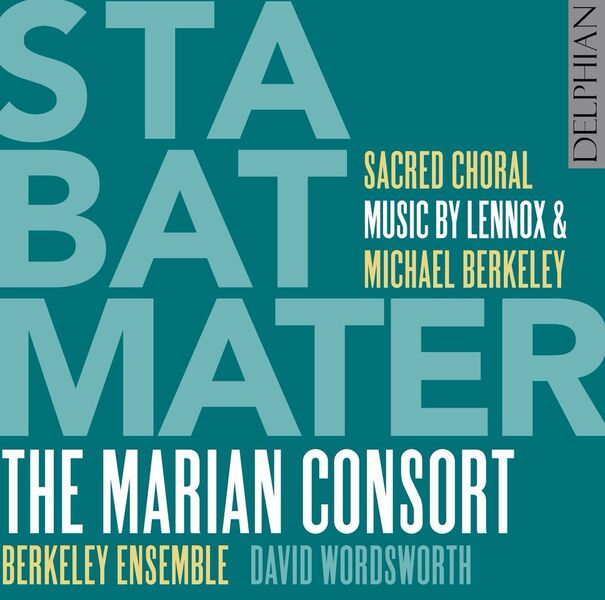
The long-awaited world premiere recording of Lennox Berkeley’s masterpiece, the Stabat Mater, sponsored by the Lennox Berkeley Society and released by Delphian Records in June 2016, has been shortlisted for the 2017 Gramophone Awards. The CD is available from Presto Classical. The recording was made by conductor, Berkeley specialist (and former Berkeley Society Chairman) David Wordsworth with the Marian Consort and the Berkeley Ensemble in the new Britten Studio at the Snape Maltings, the day after a performance in Blythburgh Parish Church on Good Friday. As part of an ambitious project conceived and masterminded by the Society, there was a subsequent performance at the Spitalfields Festival in Shoreditch Church on 7 June (later broadcast on Radio Three, introduced by the Society’s President, Petroc Trelawny, and including a revealing interview with Michael Berkeley), and there will be a further performance at the Cheltenham Festival at 4pm on Sunday 17 July in the Pittville Pump Room, preceded at 3pm by a discussion including Petroc Trelawny and Michael Berkeley. The Stabat Mater, commissioned by Benjamin Britten for an English Opera Group tour with Peter Pears in 1947, is seldom programmed because of its unconventional scoring. The Shoreditch performance was hailed by the Sunday Times on 12 June as ‘downright astonishing’. Don’t miss the recording! Also on the disc are: Lennox Berkeley’s Mass for Five Voices, written for the choir of Westminster Cathedral, and his motet Judica Me, with Michael Berkeley’s rapturous meditation on Monteverdi and Purcell, Touch Light, for soprano and counter-tenor soloists and string orchestra.
The Marian Consort and the Berkeley Ensemble accepting the applause after Stabat Mater (conducted by David Wordsworth) at the Spitalfields Festival on 7 June 2016
A Dinner Engagement at Cambridge University
May 2017
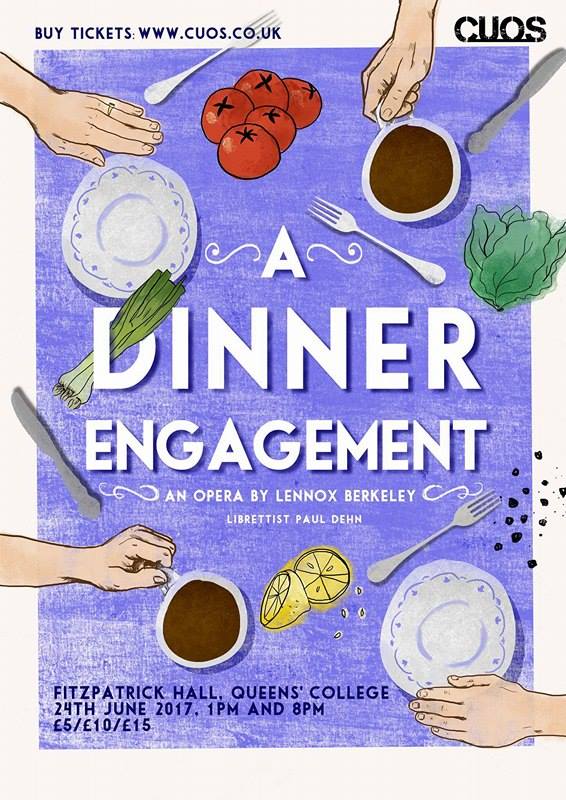
Cambridge University Opera Society is staging a production of Berkeley's one-act comedy A Dinner Engagement at Fitzpatrick Hall, Queen's College, on Saturday 24th June, at the end of May Week. It's believed to be the first time the piece has been performed in Cambridge. The producer, Anna Semple, describes the opera as 'a frothy, delightful tale of love amongst the vegetables', as the impoverished Lord and Lady Dunmow prepare dinner for the rich and eligible Prince Philippe to whom they hope to marry their daughter - but 'absolutely everything goes terribly wrong'. Anna promises 'a colourful new take on Berkeley's very modern modern opera', in which despite the dramas, the first buds of young love start to open'. The musical director will be Stephanie Childress; casting is still in progress. Tickets are available through www.cuos.co.uk
A Berkeley Feast at St. John's Smith Square
January 2017
Olivia Ray
The New London Orchestra conductor Ronald Corp will be performing two of Lennox Berkeley’s most popular works in a programme of Mozart and Elgar at St. John’s Smith Square, London, on Wednesday 1 March at 7.30.
The concerns opens with Mozart’s motet Sancta Maria, in which the orchestra will be joined by the London Chorus, and the Missa Brevis, with soloists Olivia Ray, Augusta Hebbert, Alessandro Fisher and Joseph Kennedy. Then comes Elgar’s Sea Pictures, in an arrangement for choir and strings by Donald Fraser. And the programme is completed by Berkeley’s Four Poems of St. Teresa of Avila and the Serenade for Strings.
The soloist in the Teresa Songs will be the mezzo-soprano Olivia Ray, who studied at the Royal Northern College of Music, English National Opera's programme for young opera singers, The Knack, and the Guildhall School of Music and Drama. In recent seasons Olivia has made her mark at Grange Park Opera as Flora in La Traviata, Enrichetta di Francia in I Puritani and Soeur Mathilde in Dialogues des Carmélites. Berkeley won’t be unfamiliar territory, although the roles are as far apart as can be imagined: in 2004 she sang the part of Mrs Kneebone in the one-acter A Dinner Engagement on an East Anglian tour with Opera East.
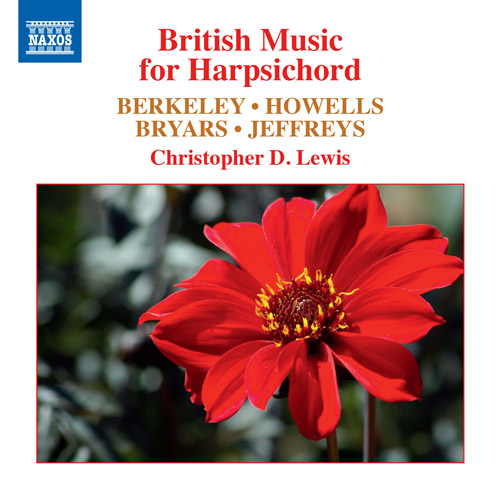
A harpsichord suite which Lennox Berkeley wrote when he was 27 has been found in the Berkeley manuscript collection at the British Library and published for the first time by Chester Music. The Suite for the Harpsichord dates from the middle of Berkeley’s studentship with Nadia Boulanger in Paris in 1930, and is dedicated to his friend, the amateur harpsichordist Vere Pilkington, for whom he wrote a number of earlier keyboard works while they were both at Oxford In the Twenties. The work has been edited by the young harpsichordist Christopher D. Lewis, who gave what is thought to have been the world premiere at Mottisfont in October. It’s in five distinct movements, starting with a powerful ‘Lento’ and ending with a tuneful ‘March’; it lasts about a quarter of an hour. The new publication costs £8.99 and is available from Chester Music.
Bazouker
October 2016
Lennox Berkeley’s paternal grandfather and namesake is the subject of a handsome new book by Tony Scotland. All families have a black sheep, some can rustle up a whole flock. In a recorded history stretching back to the Anglo-Saxons, the Berkeleys of Berkeley Castle have fielded more than their fair share of cads. One was involved in the murder of Edward II, another sparked a war with America, a third falsified the records to try to prove his children were legitimate, and two gave the castle away to spite their next of kin. One of the family’s most colourful scoundrels was Captain Lennox Berkeley, the 7th earl. Wife-stealer, Bashi-Bazouk and Redshirt, chronic gambler and zither-player, he died a bankrupt and outlaw, leaving three sons, only one of whom was legitimate. The eldest, Hastings, became a captain in the Royal Navy (and father of Sir Lennox), the second, Ernest, was a British Consul, and the third, Randal – the only legitimate son – inherited the earldom, the castle and a vast fortune. On Randal’s death without issue the title fell into dormancy, and the castle was willed to distant cousins. Tony Scotland, author of a biography of the composer (Lennox & Freda, Michael Russell Publishing, 2010), has pieced together the few remaining records to tell the story of the Berkeleys’ most elusive black sheep.
BAZOUKER: The untold scandals of Captain Lennox Berkeley, 7th Earl of Berkeley is designed by Libanus Press and published by Shelf Lives. A slim volume of 64 pages, with 18 photographs and a new Berkeley Pedigree, it is available on amazon.co.uk at £15 plus postage, but Tony Scotland is offering a special price of £10 including postage for members of the Lennox Berkeley Society. Please contact the publisher at Shelf Lives through shelflives@icloud.com.
Berkeley's Shakespeare Music
September 2016
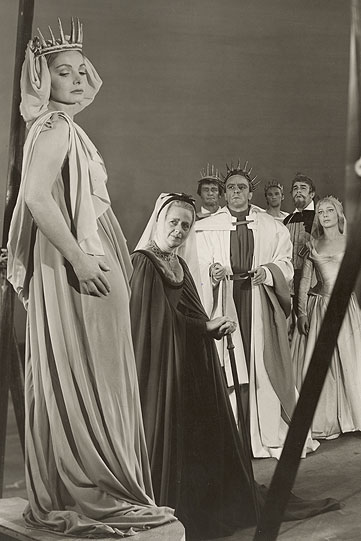
Peggy Ashcroft as Paulina (second left) in Peter Wood's production of The Winter's Tale at Straford in 1960
Incidental music which Lennox Berkeley wrote for a production of The Winter’s Tale at the Shakespeare Memorial Theatre in Stratford in 1960 has been revived by the Royal Shakespeare Company for a concert of modern British Shakespeare music in London, later this month. It’ll be played by the Southbank Sinfonia (conductor Simon Over) in a programme including Vaughan Williams’ music for Richard II and Rubbra’s for Macbeth. Guest actors taking part in the concert include Patricia Hodge, David Threlfall and Samuel West. The concert will take place at St John’s, Smith Square, starting at 7.30 pm and in a pre-concert talk at 6.30 pm, Bruce O'Neil, Head of Music at the RSC will reveal more about the company’s mission to bring its historic scores back to life. A suite of nine movements from The Winter’s Tale score was published by Chester Music in 1962. Berkeley also wrote incidental music for a production of The Tempest at Stratford in 1946, and Decca recorded some of the songs from it. Scores of both these Shakespeare settings can be found at the British Library.
Berkeley Treasures from Lyrita
September 2016
Richard Itter right, with Sir Adrian Boult, the conductor who played a significant role in his move into orchestra recording
Continuing their releases of the Itter Broadcast Collection, Lyrita Records have just brought out a new CD [REAM1129] of three major Berkeley religious works, in performances which were originally broadcast on BBC Radio Three and have never been commercially available before. The first work on the new disc is the Stabat Mater (1947), performed by soloists of the Ambrosian Singers with the English Chamber Orchestra conducted by Norman Del Mar, in the Friends’ Meeting House, London, and broadcast in 1965. This will be particularly interesting in the light of our own, Lennox Berkeley Society, CD of the same work recorded by Delphian with the Marian Consort and the Berkeley Ensemble conducted by David Wordsworth. Read John Quinn’s fascinating review, comparing both recordings - and buy the disc - on the Music Web International website. The second work on the Lyrita disc is the cantata, Batter My Heart, Three-Person’d God (1962), with the soprano Felicity Harrison, the organist Donald Hunt, the BBC Northern Singers and members of the BBC Northern Sympthony Orchestra, conducted by the composer, and broadcast in 1963; this was the work’s UK premiere, the first performance having taken place in New York with the Riverside Church Choir, which commissioned it. And the third work is the world premiere of the Magnificat (1967-8), with the Choirs of St Paul’s Cathedral, Westminster Abbey and Westminster Cathedral, and the London Symphony Orchestra, conducted by Berkeley himself, in St Paul’s Cathedral, and broadcast in 1968. All three broadcasts were recorded off transmission by the enterprising founder of Lyrita, Richard Itter, on professional equipment he installed at his home in Burnham. These are just three of some 1500 British works he recorded from 1952 to 1996 - broadcasts which, but for Richard Itter, would have been lost to history. In 2014 the Lyrita Recorded Edition Trust begun to transfer this priceless archive, and has now put in place formal agreements with the BBC and the Musicians Union to enable the public release of items from it. Read more about Richard Itter and the Lyrita project on the Lyrita website.
Stabat Mater recording is 'a major statement'
July 2016
David Wordsworth
To mark the release of Delphian's stunning CD of Berkeley's great Stabat Mater, recorded in Blythburgh on Good Friday, the conductor David Wordsworth has given an interview about the work on the Presto Classical website. He describes the Stabat Mater as showing not only Berkeley's 'very particular voice', but 'a rather more passionate and intense side of his musical character'. It really is, he tells Katherine Cooper, 'a major statement'. Read the full interview, describing the birth of the Society's Stabat Mater project, Wordsworth's determination to use a vocal ensemble that blends with the instrumentalists, and his ideas for future Berkeley recordings.
And to take advantage of a special introductory offer for the purchase of the new disc, press 'More' at the foot of the interview, which will take you to the Presto shop. The offer expires on August 31, 2016.
Lennox BERKELEY (1903-1989) Stabat Mater, Op 28 (1947) [32:17]
Mass for Five Voices, Op 64 (1964) [13:45] Judica me, Op 96 No 1(1978) [7:19] Michael BERKELEY (b. 1948) Touch Light (2005) [7:35]
The Marian Consort/Rory McCleery; Berkeley Ensemble/David Wordsworth
rec. 26-29 March 2016, The Britten Studio, Snape Maltings, Aldeburgh
Latin texts and English translations included DELPHIAN DCD34180 [60:59]
Religious music was an important strand in Lennox Berkeley’s compositional output – he became a Roman Catholic in 1929 – though it was only in the 1940s that he started to compose music for liturgical use.
One of his most important religious works was his setting of the Stabat Mater. I’m not entirely sure if the present recording is its first – in his excellent notes David Wordsworth says it has “never [been] recorded on CD” - but I rather suspect this is the first recording. On the face of it that’s a surprise since the work is eloquent and important. However, Wordsworth tells us that the score was neglected after a 1953 Aldeburgh Festival performance until the mid-1970s so it clearly fell out of fashion. I wonder if part of the reason is the forces required. It is scored for six voices (SSATBB) and I’m sure it could only be performed by six solo voices – and very good ones at that - since a larger group of singers would upset the equilibrium with the accompaniment. The instrumental forces comprise a woodwind quintet, string quartet, double bass, harp and percussion. It seems to me that one of Berkeley’s many achievements in this score is to transcend the ‘limitations’ of the fairly small forces; often the work seems to be a bigger piece.
The medieval Latin text is here divided into ten short movements. Berkeley varies his forces imaginatively so that the full ensemble is only needed in the first and last movements. Elsewhere there are two movements for vocal quartet. There’s a duet for two sopranos in the second movement and for the rest solo voices are employed. I mentioned Berkeley’s ability to make his music sound bigger than the forces involved. We get a case of that in the opening movement. Here, after a somewhat cool instrumental introduction the writing becomes altogether more intense, especially at the passage beginning ‘Cujus animam gementem’.
Later on, the fourth movement ‘Pro peccatis’ is sung by a vocal quartet and the writing for both the singers and instrumentalists is very dramatic; there’s plenty of tension in both the music and the performance. The following movement, ‘Eia, Mater’ is a tenor solo containing music of intense lyricism. Benedict Hymas does this very well indeed. There’s plangent and strongly focused singing from Rory McCleery in the seventh movement, an alto solo (‘Fac me tecum pie flere’). The section that follows, ‘Virgo virginum praeclara’ is for SATB quartet and the instruments are silent for almost the entire movement; here the vocal writing features very close harmonies. The last movement, ‘Christe, cum sit hinc exire’, reunites the full ensemble, starting with an extended instrumental introduction – as in the opening section. Here the singers exhibit great commitment, delivering a deeply-felt performance. For the last minute or so the music becomes much more subdued and attains a gentle radiance which brings the work to a very satisfying conclusion.
I don’t believe I’ve ever heard the Stabat Mater before but I have no hesitation in saying that it’s a marvellous work. Berkeley responds to the text with great feeling and sensitivity and though inevitably the tone is very serious there’s no want of variety in the music. The score’s cause is helped by the fact that it receives a searing and expert performance. This may be the work’s debut on disc but it’s been worth the wait to hear it in a performance of such quality.
The Mass for Five Voices (SSATB), in which the Marian Consort is directed by Rory McCleery, was composed for the choir of Westminster Cathedral in 1964. David Wordsworth points out that its composition came during an extended period in which Berkeley “experimented liberally with twelve-note procedures”. Perhaps that accounts for the austere, even astringent nature of some of the writing. I would imagine that the Westminster choir found it a challenge although doubtless the challenges were successfully met under the guidance of Colin Mawby, then the Director of Music. The music is often unsettled and I have to say that I found it music that I admired but did not find it easy to come to terms with. I rather suspect I would find it easier to assimilate if the movements were heard individually in a liturgical context. The movement which exerted the strongest appeal for me was the Agnus Dei where the writing has a grave beauty and achieves a very gratifying sense of repose.
A much stronger appeal to the senses is exerted by the a capella motet Judica me (SSATBB) which was composed for the 1978 Three Choirs Festival. This is a setting of verses from Psalm 42. David Wordsworth rightly draws attention to echoes of Poulenc, especially near the start. The harmonies are often searching, though often warm, and the vocal lines flow beautifully. I imagine that the piece was intended for performance by a full choir – probably at Evensong – but the use of just six voices here ensures that the part writing is heard with tremendous clarity. For the most part the music is reflective and prayerful in tone though Berkeley is briefly joyful at ‘Confitebor tibi in cithara, Domine’ (‘I will sing your praises on the cithara, O God’). This lovely piece receives a super performance here. My only slight regret is that the companion piece, Ubi caritas et amor was not also included – the two were published together as Op. 96.
To complete the programme we hear a single work by Lennox Berkeley’s son, Michael. Touch Light, for which he provided his own text, was written for the Tetbury Festival in 2005 to celebrate a marriage. It’s scored for soprano and alto soloists (Zoë Brookshaw and Rory McCleery) and string quintet. This is the only piece on the disc for which the text is not, at first sight, provided. In fact, it’s contained within the notes, so all is well. The two singers are given rapturous lines to sing against what is a kind of ground bass accompaniment from the strings. Here, the singing is ecstatic, both soloists offering great intensity. This piece by Berkeley fils is a fine complement to his father’s music.
This is a very important disc in that it presents an unjustly neglected English vocal work of the highest quality; furthermore, the performance is superb. Indeed, all are top quality and if my admiration is greatest for the setting of Stabat Mater the music that constitutes the remainder of the programme is also distinguished. Previously I’ve only heard The Marian Consort in Tudor consort music but here they prove themselves equally adept in twentieth century repertoire while the Berkeley Ensemble make a fine contribution also.
It’s very fitting that the recording should have been made at the Snape Maltings for it was Benjamin Britten who prompted Berkeley to write the Stabat Mater. Many of the previous Delphian discs I’ve heard have been recorded in churches but the results obtained in this secular venue are just as impressive. The sound is clear, vivid and expertly balanced.
Admirers of Lennox Berkeley’s music should put this disc at the top of their shopping list
These artists will be offering a rare chance to hear a live performance of the Stabat Mater in a concert at the Cheltenham Music Festival on Sunday, 17 July 2016. The programme will also include Touch Light: (details here).
Reproduced by kind permission of John Quinn and Music Web International (the largest non-commercial classical music resource on the web, which posts ten new reviews each weekday at www.musicweb-international.com.
Mexican guitar Sonatina video released
June 2016
The guitarist Jesús Martinez Garnica approached the Society in 2015 with the idea of making a video recording of the Sonatina Op. 52 no.1. With help and encouragement from the Society, the project went ahead and the delightful result is shown here.
Jesús was born in Mexico City in 1988 and began playing the guitar at the age of 13. He went on to study with Juan Carlos Laguna, and has attended masterclasses with David Russell, Carlos Bonell and other distinguished guitarists. Jesús has performed as soloist with orchestras, and in 2013 won the soloist competition of the Escuela Nacional de Musica.
He is working on another audiovisual project called Paisage virtual sonoro, which intends to bring classical music to a new, young audience by combining landscape, music and cinema.
BMS special offer on Terroni's Berkeley CD
May 2016
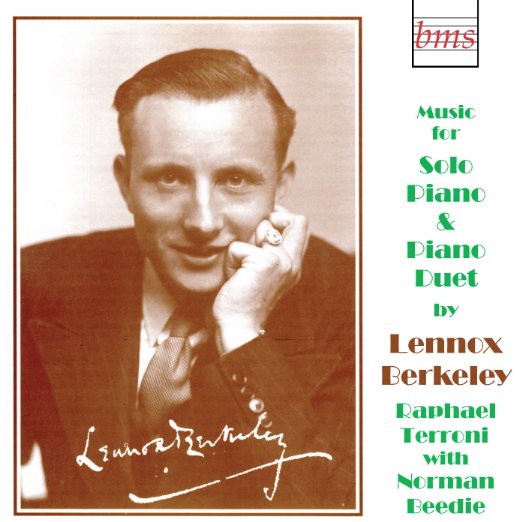
The British Music Society has a small remaining stock of the original issue of the recording by Raphael Terroni and Norman Beedie of piano music by Lennox Berkeley for solo and duet, on BMS 416CD, and the Hon. Treasurer of the BMS, Stephen Trowell, who is a member of our own Society, has offered to let us have this disc, while stocks last, at the special price of £5 a copy, including UK postage (overseas postage details on application). If you would like to order, please send an email to stephentrowell43 at gmail dot com. Reviewing the CD in the Gramophone in 1994, Peter Dickinson said, 'This is some of the finest British piano music of the century'. Our foundress, Kathleen Walker, has long been an admirer of the artistry of the late Raphael Terroni, and she points out that this original disc would make a welcome present for any musician.
Two new Berkeley recordings released
April 2016
Two new CDs of rarely heard works by Lennox Berkeley have just become available. One is a recording of his two early pieces for harpsichord, written for his friend Vere Pilkington while both were still at Oxford in the 1920s: Mr Pilkington's Toye and For Vere. They are played by the young Welsh harpsichordist, Christopher D. Lewis, who is studying Berkeley's harpsichord music as part of his PhD programme at Southampton University; he writes about this in the current issue of the Berkeley Society Journal. The Berkeley works come in a compilation of modern British harpsichord music, with works by Herbert Howells, John Jeffreys and Gavin Bryars, on Naxos 8573668.
The other new recording is on Lyrita SRCD353: the complete chamber music & songs with harp by Edmund Rubbra, plus two other works for solo harp, Berkeley's Nocturne of 1967 and Howells' Prelude No 1 of 1951. The harpist is Danielle Perrett who recalls that the Berkeley piece was written for the brilliant teenage harpist Hannah Francis, and notes that it is a delightful work not often performed,'which is a pity, as it is fully characteristic of the composer'. The Executive Producer of this new disc was Adrian Yardley (a son of Rubbra, and a member of the Berkeley Society), who writes about the Catholic links between Rubbra and Berkeley in the new Berkeley Society Journal.
First Symphony takes to the skies in memory of Lady Berkeley
April 2016
World travellers flying by Emirates will soon have the chance to hear music by Lennox Berkeley. In a concert of music by teachers and their pupils, the composer and broadcaster Chris de Souza, who has presented the airline's Classical Channel for twenty-five years, has programmed the 'Lento' movement from the First Symphony - and dedicated it to the memory of Freda Berkeley. By a curious coincidence Berkeley found the key to the start of this symphony on his very first flight, from London to Jersey in the summer of 1936, though he didn't return to serious work on it till 1941, when he was staying at Berkeley Castle. The pupil paired with Berkeley is the late Sir John Tavener, who said of the First Symphony that it possessed a delicacy reminiscent of Mozart. Chris de Souza, who has been an admirer of Berkeley's music for many years, said that hearing the piano concertos in the Chandos recordings had inspired him to continue with his own composing. He has long been a friend of the family, and is a member of the Berkeley Society.
TS
Festival performances and first recording of the Stabat Mater
March 2016
In the most ambitious project it has ever undertaken, the Lennox Berkeley Society has organised, and found the funding for, a recording and three prestigious performances of one of Berkeley's greatest works, the Stabat Mater – the Latin hymn to Mary at the Cross. The first concert took place on Good Friday, 25 March at 6.00pm in Blythburgh Church, performed by the Marian Consort and the Berkeley Ensemble conducted by former chairman of the LBS, David Wordsworth. The concert will also feature music by Michael Berkeley and Benjamin Britten. During the following days, a CD of the Blythburgh programme will be made in the Britten studio at Snape by Delphian Records. Tickets for the concert are available online. Two further performances of the Stabat Mater, with the same forces, are planned for the summer. The first – part of the Spitalfields Festival – will take place in Shoreditch Church on 7 June at 8.00pm (download flyer), and the second will be on Sunday 17 July at 4pm in the Pittville Pump Room as part of the Cheltenham Festival. Tickets can be bought online or by telephone to the box office on 01242 850270. The work is dedicated to Benjamin Britten, who conducted the first UK performance, with the English Opera Group (and soloists including Peter Pears) in the Friends House, Euston, on 26 September 1947, five weeks after the world premiere in Zurich, which Berkeley himself conducted.
The Society is dedicating the performances of the Stabat Mater to the memory of its late Patron, Lady Berkeley.
Lady Freda Berkeley
24 February 2016
It is with deep sadness that we have to announce the death of our Patron, Lady Berkeley, peacefully, at the Kensington Nursing Home, on Sunday afternoon the 21st February, aged 92.
An Old Rite Latin Requiem Mass took place in Freda’s parish church, St. Mary of the Angels, Moorhouse Road, London W2 5DJ, at 10am on Monday 29th February, and burial followed at midday in All Souls Cemetery, Harrow Road, Kensal Green, London W10 4RA.
For those who were unable to attend there will be a memorial concert on another occasion.
(This photograph was taken at the Kensington Nursing Home on 27th February last year by Freda’s neighbour at Hereford Mansions, Dr Edesio Fernandes, and reproduced with his kind permission.)
Berkeley Ensemble CD wins a Gramophone Critics' Choice of the year
20 December 2015
The Berkeley Ensemble's all-Berkeley CD, Lennox Berkeley Chamber Works (Resonus RES10149) has been selected by the Gramophone magazine as a Critics' Choice of 2015. In the December issue Peter Dickinson writes that 'The outstanding young Berkeley Ensemble has gained first-rate reviews for this second CD - all well-deserved … A most enjoyable collection in every way'. See our earlier Headline: Another Accolade for the Berkeley Ensemble, 4 August 2015.
A Berkeley Premiere
6 December 2015
The Lennox Berkeley Society is pleased to announce that the first UK public performance of Berkeley’s early Sonata for Violin and Piano No.1 is to be given at the Royal College of Music in London on Friday 19th February 2016. The violinist will be Emmanuel Bach, who is studying for a Masters degree at the RCM, having graduated from Magdalen College, Oxford, with a First in music. (Emmanuel and the pianist Jennifer Stern played the sonata for members of the Committee of the Berkeley Society at a private concert in Hampshire in January this year.)
The Society’s President, Petroc Trelawny, will introduce the concert, which also includes works by Berkeley's teacher, Nadia Boulanger, by Stanley Bate (also a pupil of Boulanger) and by Bate’s other teacher, Hindemith. To complement the programme the RCM Library will be exhibiting original manuscripts from its own collection, including the violin part of the Berkeley sonata. The display will also include the new Chester Music/Music Sales publication of the sonata, and the CD made by the violinist Edwin Paling and the pianist Arabella Teniswood-Harvey of the first-ever recording of the sonata (on the Australia label Move Records MD 3361). The composer’s second son, Julian Berkeley, will be contributing to this small exhibition some memorabilia of his own – letters, photos, and a diamond pin – given to him by Nadia Boulanger, who was his godmother. The Society is hoping that this concert will herald a new association with the Royal College of Music, introducing more students to the work of Lennox Berkeley. The concert is free, but tickets are required; for further details see here.
John Mark Ainsley records Five Auden Songs
9 October 2015
In a new CD called French Connections, the tenor John Mark Ainsley and the pianist Malcolm Martineau perform Lennox Berkeley’s Five Poems of W. H. Auden, in a programme that includes Poulenc’s Tel jour, telle nuit, Britten’s The Holy Sonnets of John Donne and a set of songs by the American composer Jake Heggie, paying homage to Poulenc through four of his formative friendships. Berkeley set his five Auden poems in 1958 to a commission from the American soprano and patron Alice Esty, who gave their first performance in New York. Given the complicated relationship of Berkeley, Britten and Auden, it is significant that all but the first of the poems, Lauds, had already been set by Britten. But, although the friendship of Auden and Britten is better known, the friendship of Auden and Berkeley went further back, for the two first became friends as undergradutes at Oxford, when Berkeley set two Auden poems, which the poet C. Day Lewis sang for the first time at the Oxford Musical Club and Union in 1926. The new disc, produced by Linn Records (CKD 477), will be available from 13 November.
Shakespeare – and Wordsworth
17 September 2015
The conductor and pianist David Wordsworth, a former Chairman of the Lennox Berkeley Society, has compiled and edited a Shakespeare Choral Collection for Novello Publishing, to mark the four hundredth anniversary of Shakespeare’s death in April next year. The collection of 26 works features established settings such as Thomas Arne's Blow, Blow, Thou Winter Wind and Henry Leslie's How Sweet The Moonlight Sleeps as well as more recent works – Ernest Moeran's Sigh No More, Ladies, and John Tavener's Fear No More – and several new works specially commissioned from John Joubert and Richard Sissons, amongst others. Included in the anthology is Lennox Berkeley’s Hymn for Shakespeare’s Birthday [in 1972] which sets a text by C. Day Lewis. David Wordsworth has written a fascinating introduction to the collection, together with notes describing each piece. The new volume is available from Novello’s. David Wordsworth is also Artistic Director of ‘Singing Shakespeare’, a major project supported by the Shakespeare Birthplace Trust and running through to the four hundredth birthday next Spring. ‘Singing Shakespeare’ focuses on choirs all over the world singing new and existing settings of Shakespeare texts. David conducted choirs from Stratford-upon-Avon in the launch concert at Holy Trinity, Stratford in April 2014, in a programme that included Vaughan Williams’ Serenade to Music, as well as a newly-commissioned work from Gary Carpenter and Stephen Sondheim’s song Fear no More in a new arrangemend made by David himself with the permission of the composer.
Another Accolade for the Berkeley Ensemble
4 August 2015
The Berkeley Ensemble’s much-praised all-Berkeley CD, Lennox Berkeley Chamber Works (Resonus RES10149) has been selected by BBC Music Magazine as the ‘Chamber Choice’ or September. In his five-star review, the writer, pianist and broadcaster Roger Nichols, one of the leading scholars of nineteenth- and twentieth-century French music*, praises the ‘stylish’ and ‘very enjoyable’ album, adding that ‘the playing is superb throughout’: ‘the Berkeley Ensemble do their namesake proud’. Nichols also draws attention to the five-star quality of the recording itself, and to Tony Scotland's ‘elegant, illuminating notes’. Reviewing the same CD in the Sunday Times, Paul Driver wrote: ‘Outstanding in the exuberantly performed sequence are the expressive central adagio of the Op 19 String Trio and the 1971 Introduction and Allegro for double bass (Lachlan Radford) and piano (Libby Burgess).’ Geoffrey Norris, in the Sunday Telegraph, awarded the new disc four stars, noting the ‘high quality of the performances’ and saying that the ensemble ‘plays as if it were truly inside the music’. You can read more about the CD, sample the tracks, and order your copy at http://www.resonusclassics.com/lennox-berkeley-chamber-works.
*Roger Nichols is the author of biographies of Ravel and Debussy, and of The Harlequin Years: Music in Paris 1917–1929.
The Berkeley Ensemble (photo Belinda Lawley)
London Festival of Contemporary Church Music
16 May 2015
The internationally-renowned vocal ensemble the Marian Consort will perform works by Berkeley father and son in a programme of British sacred music influenced by the music of the Renaissance, at the London Festival of Contemporary Church Music in St Pancras Church, London, on 16 May 2015 at 7.30pm. From the austere beauty of Lennox Berkeley’s Mass for Five Voices and Michael Berkeley’s motet Ego dilecto meo to Gabriel Jackson’s alternatim Magnificat setting for Truro Cathedral, the programme has been conceived as part of the liturgy of today, while capturing the essence of the past. The Marian Consort are also joined by Oxford Youth Choir and the Lacock Scholars for the second performance of Emily Levy’s In Paradisum, written for The Marian Consort, SATB choir and children’s chorus, which sets portions of the Latin Requiem rite juxtaposed with poetry by Andre Dubus on the themes of loss, hope and consolation.
2015 Berkeley Society Journal out now
The new edition of the Berkeley Society Journal offers an instructive and entertaining collection of articles and photographs about Berkeley and his music. As an introduction to the operatic double bill at the Royal Academy of Music on 14 May, when students will perform Berkeley's comic opera A Dinner Engagement and Walton's extravaganza The Bear, Michael Berkeley gives an insight into the friendship between the two composers; performer, teacher and composer Richard Leigh Harris writes about his personal Best of Berkeley; Tony Scotland reveals the use of Berkeley's Divertimento as cultural propaganda just after the war - and unmasks the penultimate Countess of Berkeley as the musical comedy star Edith Brandon; American online critic Steve Schwartz examines Berkeley's sacred choral music; Scottish composer John McLeod recalls his period of study with Berkeley in 1959; and Swedish-Greek guitarist Ioannis Theodoridis analyses Berkeley's Theme & Variations for Guitar - and finds traces of Beethoven. You can read the whole of Theodoridis' thesis here - or the edited version and all the other articles in the new Journal by joining the Berkeley Society now.
New Publications
15 December 2014: Violin Sonata No. 1
The success of the new CD of the Complete Music for Violin and Piano and Solo Violin, played by Edwin Paling and Arabella Teniswood-Harvey (see below) encouraged the Lennox Berkeley Society to seek publication of the manuscript of Lennox Berkeley's Violin Sonata No.1. J & W Chester have now made this exciting the work available, and Paling and Teniswood-Harvey's performing score has been consulted for this first publication, which has had the support of the Society. The source is a manuscript in a copyist’s hand now at the British Library. Violin and Piano score available at £15.95 from:
3 November 2014: Composer Portraits Lennox Berkeley
Following the centenary publication of Chester Music's comprehensive volume of the Collected Works for Solo Piano, Wise Publications have recently published a new collection of Lennox Berkeley's piano pieces, as an introduction to the composer's music, in their COMPOSER PORTRAITS series. The selection is arranged with a descriptive text by Peter Dickinson preceding each of the chosen pieces and there is biographical preface by Michael Berkeley. The volume is available at £9.95 from:
Sonatina performed in Royal College of Music Recital Series
14 June 2014
French flautist Luce Zurita and British pianist Frederic Bager, both students of the Royal College of Music in London, performed the Berkeley Sonatina in a programme with Fauré’s Fantaisie and Reinecke’s Undine Sonata at the RCM Recital Series at the Trinity Music Academy on 14 June. Frederic gave Luce a copy of the Berkeley Society leaflet and she told us, ‘I read pretty much everything and it was really inspiring before playing the Sonatina, which is a little jewel as we say in French! I am going to play it again for a scholarship audition, and I would be very happy to feature either the Sonatina or the Sonata next term at RCM with Freddie’. As an orchestral freelance Luce plays with the Philharmonic and Symphony Orchestras of the RCM, and the Orchestra of the Opera of Rouen; as a soloist she will be joining the harpist Valeria Kurbatova for the world premiere of a double concerto by Darrell Davison, with the Epsom Symphony Orchestra, in Epsom on 18 October. Frederic, who is a member of the Berkeley Society, was raised in Switzerland and began playing the piano at the age of four. He won first prize in the Swiss Young Musicians Contest in 2005, and he was a keyboard finalist in the 2010 BBC Young Musician of the Year competition. At the RCM he studies with Andrew Ball.
Lennox Berkeley and the Classical Guitar
12 May 2014
The Royal Academy of Music has repeated – and expanded – the Berkeley elements of the Lennox Berkeley Society Guitar Day programme to celebrate Lennox’s birthday on May 12, and to mark 25 years since his death. The new programme included three more of Berkeley’s guitar works – the Quatre pièces he wrote for Segovia, Theme and Variations written for Angelo Gilardino, and the Concerto commissioned by Julian Bream - to offer a survey of his complete oeuvre for the instrument. The concert was given by Academy students.
Monday 12 May 2014, 6:00 pm in the David Josefowitz Recital Hall, RAM
Artists: Julian Gregory, tenor, Michael Butten, Mircea Gogoncea, Andrey Lebedev and Merlin Miller, guitars
Music: Berkeley Quatre pièces; Sonatina, op.52 no.1; Songs of the Half-Light, op.65; Theme and Variations, op.77; Concerto, op.88
Lennox Berkeley was professor of composition at the Academy from 1946 to 1968.
Berkeley's guitar music explored at the Royal Academy of Music
This year we explored Lennox's writing for the guitar, with performances of the Sonatina Opus 52 and Songs of the Half Light. Passionate about the guitar, Berkeley found the ideal collaborator and interpreter in Julian Bream. Both works were written for Bream, and the event will consider his influence on Lennox's writing – we hope to have contributions from Bream himself. Britten's Nocturnal, another Bream work, will also feature, along with songs by John Dowland, who so influenced both men.
As ever the concert featured rising stars from the Academy – this year guitarist Michael Butten and tenor Julian Gregory.
If you have been before you will know what a special event this is, with inspiring performance and a convivial reception following the concert.
The Royal Academy of Music Berkeley Day is generously supported by Noriyuki Ida in memory of his daughter Kumiko Ida, a former RAM student and member of the Berkeley Society committee.
Petroc Trelawny, Chairman
Berkeley at the Proms
April 2013
Sarah Connolly (left), one of the UK’s most celebrated classical artists, sang Lennox Berkeley’s Four Poems of St Teresa of Avila at the BBC Proms this year. The mezzo-soprano joined the Britten Sinfonia and conductor Sian Edwards in a performance of a work originally written in 1948 for Kathleen Ferrier. The concert, at 3pm on Saturday 3rd August, took place at the Cadogan Hall just off Sloane Square. A week later Camerata Ireland, conducted by the acclaimed Irish pianist Barry Douglas, performed the Serenade for Strings, in a programme pairing music of Benjamin Britten with that of his contemporaries. And on August 24th, the English Chamber Orchestra conducted by Paul Watkins, performed Sellinger’s Round, a set of variations on an Elizabethan theme composed by Berkeley, Britten, Arthur Oldham, Humphrey Searle, Tippett and Walton, for the coronation in 1953. The performance included the premiere of new variations by Tansy Davies and John Woolrich. All three concerts were broadcast live on BBC Radio 3. ‘We are thrilled that three of Lennox’s works featured in this year’s Proms’, said Berkeley Society chairman Petroc Trelawny. ‘They represented a spectacular return to the festival where he enjoyed so many successes, with past performances of all four symphonies, three concertos and various liturgical and other works. It’s been a decade since his music has been heard at the Proms, and this year’s Berkeley focus is another illustration of the desire of the Proms director, Roger Wright, to celebrate as fully as possible Britain’s musical heritage’.
Organ Music by Berkeley Father and Son
April 2013
Exciting news from Resonus Classics, the world's first solely-digital classical label. The young organist Tom Winpenny has made the first recording of the complete organ works of Lennox and Michael Berkeley. The recital is given on the renowned 1962/2009 four-manual Harrison & Harrison organ at St Albans Cathedral, where Tom is Assistant Master of the Music and organist of the daily choral services. Among the ten tracks are two world premiere recordings – Impromptu (1941) by Lennox Berkeley and Sonata (1979) by Michael Berkeley – plus Three Pieces for Organ Op. 72 No. 1 and Fantasia Op. 92 by Lennox, Wild Bells (1986) by Michael, and Andantino, arranged by Jennifer Bate from Lennox's Festival Anthem. Tom Winpenny began organ lessons under John Scott Whiteley while a chorister at York Minster, and continued as a Music Scholar at Eton College, and as Organ Scholar at Worcester Cathedral, St George's Chapel, Windsor, and King's College, Cambridge, where he graduated with a degree in music. His recording (Resonus RES10104) and an attractive and comprehensive booklet (including notes by Andrew Benson, photos of Berkeley father and son and of Tom Winpenny, with photos of the Harrison organ and its specification) is available for download from http://www.resonusclassics.com/berkeley-organ-works
London English Song Festival 2013
The music of Lennox Berkeley featured prominently in the London English Song Festival, founded and run by pianist William Vann (see photo left), Director of Music at the Royal Hospital, Chelsea, and a luminary of the first Berkeley Days at the Royal Academy of Music. The festival started with a choral concert at the Royal Hospital on Thursday 2 May, and then moved to the Forge, Camden, for three recitals. There were also two ‘Bring a Song’ sessions for amateur singers, providing a chance to perform in a workshop situation in the wonderful Forge acoustic. The second concert at the Forge, on Sunday 5 May, included Berkeley's Three Greek Songs (which Vann performed with the mezzo soprano Katie Bray, another RAM graduate, at the Machynlleth Music Club on 12 April), Another Spring, ‘Late Spring’ from Five Chinese Songs and the Sonatina for solo guitar.
Exciting Violin Recording
April 2013
An important premiere recording of Lennox Berkeley’s complete music for solo violin and violin with piano has been published by the independent and long-established Australian classical music label, Move Records. The artists are the distinguished English violinist Edwin Paling, formerly Concertmaster of the Royal Scottish Symphony Orchestra and now Head of Strings at the Tasmanian Conservatorium of Music, and the Australian pianist Arabella Teniswood-Harvey, who teaches piano, music history and art theory at the University of Tasmania. The programme of seven works starts with the Violin Sonata No. 1, which Berkeley wrote in 1931 while still studying in Paris with Nadia Boulanger. Considering the confidence and strength of this short work in three movements it is astonishing that it has never been published. Paling and Teniswood-Harvey worked from a photocopy of the autograph score in the British Library, with the scholarly assistance of Professor Peter Dickinson and Dr Nicolas Bell. Like the Sonatina Op 17 (1942), the first Sonata is dedicated to Berkeley's elderly friend and admirer, the violin-playing Gladys Bryans. The programme ends with the Sonata No 2 (1932) which is dedicated to Mlle Boulanger, and shows more of the influence of Stravinsky (whose son Soulima was a friend of Berkeley and a fellow Boulanger student). It must have been a challenging programme to learn, and the warm and vivid recording captures the exceptionally high quality of the playing. The accompanying booklet includes two photos of Berkeley, young and old, and a cover painting by Alison Lazaroff-Somssich, who plays violin in the Tasmanian Symphony Orchestra. The CD (MD 3361) is available online at Buywell Just Classical or Australian Music Centre, price $25AUD. For more information visit http://www.move.com.au/disc/lennox-berkeley-violin-and-piano.
Seventy-seven years after it was first inspired by Catalan folk dancing at a festival of contemporary music in Barcelona, the vivid and masterly orchestral suite Mont Juic, composed jointly by Lennox Berkeley and Benjamin Britten, is to be given five performances by the European Union Youth Orchestra conducted by Vladimir Ashkenazy next month. The first performance will be in Interlaken, the others in Spain, including one on Friday 12 April in Barcelona itself, in one of the most wildly extravagant concert halls in the world, the Palau de la Música Catalana. Berkeley and Britten first heard the folk melodies on which the suite is based, and indeed first met, while representing British music at the 1936 Festival of the International Society for Contemporary Music. Both young men were bowled over by Catalan folk dancing, especially by the national sardana, which Lennox described as "tremendously exciting ... it remains as vivid in my memory as anything that took place in the festival itself" - and on returning to London they drew together the melodies they had jotted down, without ever letting on who had written what. The Berkeley Society has made a grant towards these performances.
One of Lennox Berkeley's most beautiful and moving works, his setting of Four Poems of St Teresa of Avila, was sung by Catherine Wyn-Rogers with the BBC Concert Orchestra conducted by Stephen Cleobury, at a concert in the Chapel of King's College, Cambridge, on the evening of Good Friday, and recorded by Radio Three for transmission at a later date. Berkeley wrote the songs for Kathleen Ferrier just after the war. The words of the four poems express St Teresa's ecstatic faith, and Berkeley matches them with music of quiet passion and intensity. Catherine Wyn-Rogers, who sang the St Teresa Poems in the much-applauded Chandos recording made by the BBC National Orchestra of Wales conducted by the late Richard Hickox, is the latest in a long line of distinguished British contraltos who have brought their own distinction to this profoundly affecting work. Dame Janet Baker, who sang the set in 1960, said years later that Berkeley's sublime settings had left an impression which she would never forget. The Berkeley Society has made a grant towards this performance.
The composer and broadcaster Michael Berkeley, C.B.E. (eldest son of Sir Lennox, and a Patron of the Lennox Berkeley Society) has been made an independent peer in the House of Lords, to increase its representation of the arts in general and music in particular. As a composer, Michael has written for the BBC National Orchestra of Wales, the BBC Proms and the Royal Ballet, and has been commissioned to write an anthem for the enthronement on March 21 of Justin Welby as the new Archbishop of Canterbury. As a broadcaster he has presented Private Passions on Radio Three for the past eighteen years, interviewing some 800 guests including artist David Hockney, Sir David Attenborough and Elvis Costello. "Michael is not only an accomplished composer", said Radio Three Controller Roger Wright, "but also an expert communicator, not least reflected in his ability to have engaging and insightful conversations with his guests. This recognition of his place in our society is hugely deserved." As a boy, Michael Berkeley was a chorister at Westminster Cathedral. He studied composition, singing and piano at the Royal Academy of Music and won the Guinness Prize for Composition in 1977. He was artistic director of the Cheltenham International Festival of Music for ten years, and is a former chairman of the governors of the Royal Ballet.
Having mourned the passing of the pianists Colin Horsley, one of our Patrons, and Raphael Terroni, the Society ends the year with the sad news of the death, at the age of 76, of another of our Patrons, Sir Richard Rodney Bennett, CBE. He was a pupil of Lennox Berkeley at the Royal Academy of Music, but teacher and pupil proved to be incompatible, since Richard was at that time interested in serialism, later studying with Pierre Boulez as influenced by his first teacher, Elizabeth Lutyens. Richard was a most prolific composer and ranged from classical orchestral, chamber, operatic and sacred works to numerous film scores, jazz and cabaret songs, moving to the U.S.A. when he felt out of sympathy with his musical life in this country, prestigious though it was. However, he retained an affection for Lennox, and the Society was delighted to welcome him back from the U.S.A. at last year's Berkeley Day at the R.A.M., where he spoke eloquently of his early studies, and the concert programme included his Summer Music. He was also an accomplished pianist and vocalist - in fact, one stands in awe of his many achievements and accomplishments.
On Wednesday 19 September, the Berkeley Ensemble launched a series of five concerts at the Forge, Camden with an evening of music that includes Lennox Berkeley's Quintet for piano and winds. Also on the programme is Poulenc (Sonata for clarinet and bassoon), Michael Berkeley's Fierce Tears, Woolrich (Favola in Musica) and Mozart (Quintet for piano and winds).
The Stealing, Borrowing and Remembering series of concerts explores how two twentieth-century masters, Igor Stravinsky and Lennox Berkeley, responded to the music of the past, re-working it in their own compositions before ultimately becoming historical figures themselves for the generation that followed. Download a flyer here.
Performances in the series include:
21 October, 11am
Mozart/Bach: Preludes and fugues arr. for string trio K. 404a; L. Berkeley: Oboe Quartet; Stravinsky: Élégie; Mozart: Oboe Quartet K. 370
28 November, 7.30pm
Mozart: Divertimento in D for strings K.136; Stravinsky: Septet; L. Berkeley: Sextet for clarinet, horn and string quartet; Britten: Three Divertimenti for string quartet; Mozart: Clarinet Quintet K. 581
10 February, 11am
Mozart: Adagio and Fugue K. 546; Stravinsky: Double Canon; Webern: Quartet op. 28; L. Berkeley: Canon in Memoriam I.S.; Haydn: Quartet op. 20 no. 5
27 March, 7.30pm
New work composed by local school children, directed by animateur Neil Valentine, and Stravinsky's The Soldier's Tale. Camden schoolchildren will borrow and steal from Stravinsky as they devise their own piece in response to The Soldier's Tale. Their new work will be premiered along with its inspiration, narrated by Richard Sisson and conducted by Rebecca Miller.
•The Berkeley Ensemble is named after Michael and Lennox Berkeley. It champions British music and unfairly neglected works alongside the standard chamber music repertory.
The Committee and Members of the Lennox Berkeley Society are delighted to hear from their Chairman, BBC Radio Three presenter Petroc Trelawny, who was arrested during a charity concert in Zimbabwe. He was freed after a week in detention - first in prison, then in hospital. All charges relating to his entry visa have been dropped, and tomorrow (Friday 1 June) he is scheduled to fly home. Petroc said he was pleased to be leaving with his 'head held high', that he had been moved by the kindness he had been shown by prisoners, police, nurses and friends, and that he was looking forward to going back to Zimbabwe to continue his charitable work for the Bulawayo Academy of Music.
Following a highly successful first season in 2011, the London English Song Festival returned to The Forge, Camden this May for a thrilling series of four concerts. Award-winning pianist William Vann accompanied ten outstanding singers and one oboist in performances of music written by more than twenty-five English composers including Lennox Berkeley. Berkeley's Another Spring was performed on 6 May.
The poetry of William Blake and Walter de la Mare featured this year in addition to a recital of music by oft-neglected female composers and a concert of songs celebrating London to mark the year of the Olympic Games. Pre-concert talks by expert speakers Richard Stokes and Rhian Samuel brought the music and words to life and 'bring a song' coaching sessions for amateur singers on the two Sunday afternoons allowed the audience to try out for themselves the experience of singing on the stage.
All four recitals took the audience through a fascinating exploration of the inimitable and ravishing songs - and poems - that are an invaluable part of the cultural heritage of this country.
The Lennox Berkeley Society Award for Guitar 2012 has been presented to Cassandra Mathews, a second year student at the Royal College of Music. Cassandra gave a beautiful performance of the Theme and Variations (op. 77), and also Alan Rawsthorne's Elegy.
The class was held at Oxford Music Festival on Sunday January 29th, where society Committee Member Christopher Daly presented Cassandra with a prize of £150 and an engraved trophy.
On Sunday 4 December on BBC Radio 3, Michael Berkeley's Private Passions guest was English porcelain expert Henry Sandon, from the BBC's Antiques Roadshow. Amongst Sandon's choices of music was Lennox Berkeley's The Lord is my Shepherd (op. 91/1). You can learn more about the programme here.
The third Berkeley Day focused on two facets of Lennox Berkeley's life; his time as a student and his work as a teacher when he was professor of composition at the Royal Academy of Music. At the centre of the afternoon was distinguished guest and former Berkeley pupil, Sir Richard Rodney Bennett. The events, in association with the Lennox Berkeley Society and with the generous support of Mr Noriyuki Ida, explored and reflected the influence of Berkeley's own teachers, as well as the influence he had on the generation of composers he taught, including Richard Rodney Bennett, John Tavener, Nicholas Maw and Brian Ferneyhough, as well as his own son, Michael Berkeley.
The controversial writer and publisher Carmen Callil — founder of the feminist press Virago — chaired a panel discussion about Tony Scotland's book Lennox & Freda, with Michael Berkeley and the author at the Times Cheltenham Literature Festival on October 16 2011.
The book is more than a portrait of an unconventional marriage between the composer Lennox Berkeley and his secretary at the BBC, Freda Bernstein — and the music it inspired. It's also about Lennox's earlier relationships with Benjamin Britten and a young airman, Freda's with a married art historian, the Oxford of the Brideshead generation, Cocteau's Paris, and the BBC in wartime; it's a record of a vanished way of life — and of the eternal peculiarities of the human heart.
If you have already read Lennox & Freda this discussion may have answered some of the questions it raises; if you haven't, you may want to. Michael Berkeley reflected on it as a son and fellow composer, Carmen Callil as a friend of Michael and a famously outspoken critic, and Tony Scotland revealed how and why he wrote the book.
The Romanian-born diva Nelly Miricioiu was a guest of Petroc Trelawny on In Tune on BBC Radio Three on Thursday 25th August. As well as talking about her life and career as one of the world's leading exponents of bel canto, and her forthcoming recital at the North Norfolk Music Festival (in the Marble Hall, Holkham, on 2 September, Norfolk), she sung live in the studio songs by Simon Rowland-Jones, Tiberiu Brediceanu - and Lennox Berkeley (whom she first met in 1982, when she gave a private recital for the family at 8 Warwick Avenue).
Singer and voice coach Sarah Dennis wrote in to inform us that Hotel Reserve, a film scored by Lennox Berkeley, was being screened by the BBC in July. She wrote, "It is a great old James Mason film and Lennox Berkeley wrote the score. Fascinating as the music must have been quite ground-breaking at the time."
Guitarist Stefan Barcsay recently sent the society a copy of his new CD, Silent Mountain, which includes Lennox Berkeley's Theme and Variations (op. 77). Committee Member Christopher Daly has reviewed the disc, describing it as 'very well shaped musically, and with a sensitive touch, always giving a feeling of nuance'. You can read the full review here, and see our full list of recordings of the Theme and Variations.
On Saturday, 5 February, the new biography Lennox and Freda was the subject of a
Radio 3 discussion with Tony Scotland, including an interview with Lady Berkeley. Music Matters presenter Tom Service described the book as "One of the greatest and most unlikely love stories of twentieth-century music."
We are pleased to announce the new offical Lennox Berkeley Society Facebook page, which aims to promote performance and recordings of the distinguished English composer.
Tony Scotland (bottom right) with guests at the Lennox & Freda launch at Daunt Books (photo Rupert Robertson)
A well-attended party held at Daunt Books in Marylebone High Street, London, has marked the launch of Lennox & Freda, Tony Scotland's revealing new book about the lives of Lennox and Freda Berkeley.
More than a biography, this is a portrait of an unconventional marriage and a record of Berkeley's generation and a vanished way of life. Drawing on his own original research, Tony Scotland presents fresh perspectives on the Oxford of Auden and Waugh; the Paris of Stravinsky, Diaghilev and Poulenc; Somerset Maugham's set on the French Riviera; Dylan Thomas, William Glock and Humphrey Searle during the Battle of Britain; Eddy Sackville-West, Tippett, Bliss and Boult at the BBC; and Britten and Pears at Aldeburgh. Lennox & Freda is published by Michael Russell.
The critics have hailed the book as ‘a superb biography’ (Rupert Christiansen), ‘a very good and satisfying read’ (John France), and ‘stylishly written and ... enthralling’
(Peter Dickinson); Francis King wrote that ‘Tony Scotland’s book ... miraculously catches ... the composer’. More reviews and further information, and buy the book here.
In a series of concerts in Mexico in September, Italian classical guitarist Marco Vinicio Carnicelli performed the Lennox Berkeley Guitar Concerto with the Orquesta de Estado de Mexico and Orquesta Sinfonica. You can now watch a video of one of these performances on Marco's website, at www.marcoviniciocarnicelli.it.
The Society’s eye-catching Journal for 2010 is now out. On the front cover is a photo of a painting of Lennox Berkeley as a student of Nadia Boulanger in Paris in 1926. Inside are 36 pages of articles about the Society’s activities over the past year.
These include the Englishman in Paris concert at the Royal Academy of Music last November, together with photographs of one of the young artists involved, and of the sponsors, the Ida family of Japan, with Lady Berkeley and Chairman Petroc Trelawny.
There's also an impressive list, compiled by co-founder Kathleen Walker, of Berkeley performances and new Berkeley recordings in 2009, and a report of the first Berkeley Award for Guitar.
Lady Berkeley talks to one of her late husband’s composition pupils, Eithne Herbage, about life with a composer. And another former student, the composer Adam Pounds, writes about his memories of lessons with Berkeley at home in Little Venice.
Co-founder Jim Nicol recalls the beginnings of the Society, and Tony Scotland finds some interesting composers and musicians in Berkeley’s family tree, including a young Scots nobleman who made music with the Mozarts in Naples in 1770.
The Tenth Annual General Meeting of the Lennox Berkeley Society will be held at 2.00pm on Wednesday 8th December 2010, at the Church of St. Mary-on-Paddington Green, St. Mary's Square, London W2 1SE.
After the meeting there will be a tea interval followed at 3.00pm by a short concert of music performed by the Berkeley Ensemble, and then farewell drinks.
Since publication of the 2010 Journal, the Society has learned the sad news of the death of founder member William Wynne Willson, following a long illness bravely borne. He was 77. Dr William Wynne Willson, who first discovered the music of Lennox Berkeley as a young pianist at school, was the designer of the Society's logo and of its letterhead, the creator of its first website and publisher of a number of Berkeley Society music editions and postcards. His own website, www.musicwww.co.uk, offering free downloads of a long list of sheet music for piano, survives as a memorial of his dedication to music. The 2011 Journal will contain an obituary. Meanwhile the Society offers its condolences to William's widow Jane, and his family.
Once again, the Lennox Berkeley Society is collaborating with the Royal Academy of Music for what will be a wonderful event on Sunday, October 31st. Berkeley, Britten and Auden will celebrate two unique English composers, and the poet who inspired them. At 4pm, an hour-long song recital will be given by a trio of exciting young singers, including the critically acclaimed mezzo-soprano Katie Bray, who appeared so triumphantly at last year's event.
The concert will be preceded, at 2.30pm, by a panel discussion on Auden and the art song — for which we'll be welcoming to the Academy perhaps the most celebrated of all accompanists, Graham Johnson, and the writer Peter Parker, author of a magisterial biography of Christopher Isherwood. I'll be chairing the event — which will be followed by a pre-concert Franco-Cornish afternoon tea, for which donations will be invited. After the recital there will be a chance to meet the artists and friends over a glass of wine.
The event is generously supported by Mr Noriyuki Ida in memory of his daughter Kumiko, who was an enthusiastic proponent of Lennox's music, and a dedicated committee member.
I hope you'll be able to join us and ensure the David Josefowitz Hall is filled once again.
Biographer Michael Holroyd explores the influence of biographer on biography, and artist on portrait, in a talk at the National Portrait Gallery. He is joined by Michael Berkeley, the subject of a recent portrait with Lennox Berkeley, and presenter of the long-running Radio 3 programme Private Passions. Michael's reflections will include his experience of reading the new biography of his parents, Lennox and Freda. 'Portraiture and Biography' is on the 7 April at 6.30pm.
Until midnight BST on 11th June 2012, Europadisc is offering a 35% discount on a selection of over 1000 CD titles, primarily full-price single CDs and SACDs. The offer includes a number of Lennox Berkeley titles, so this is a good opportunity if you haven't already bought them. They include: