Recordings of Lennox Berkeley's music
26 27 28 29 30 31 32 33 34 35 36 37 38 39 40 41 42 43 44 45 46 47 48 | Next
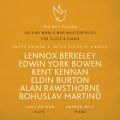
Second World War Masterpieces for Flute & Piano
 Format: CD
For this final disc in a series, the programme brings together six works spanning the Second World War era, each responding in its own way to the pressures of the time. York Bowen’s Sonata (1946) and Eldin Burton’s Sonatina (1948) come from the immediate post-war years: Bowen’s warmly expansive idiom is shot through with a charged tension that feels unmistakably like a response to the war, while Burton’s lighter, more contemporary style suggests perhaps a tentative step into a new era. Burton originally wrote the piece for piano while at Juilliard, later reworking it for flute and piano and winning the New York Flute Club’s 1948 composition prize. Kent Kennan’s Night Soliloquy (1947) is likewise a transcription of an earlier work for flute, piano, and strings (1936). Although Bohuslav Martinů’s Sonata (1944) is by a Czech composer, it earns its place here as it was written during his wartime exile in the United States. Perhaps its American setting helps explain the work’s loose-limbed, outdoorsy quality - a striking contrast to the tension coursing through many European works of the same period. The two earlier British works - Alan Rawsthorne’s Four Bagatelles for solo piano (1938) and Lennox Berkeley’s Sonatina (1939) - were written on the eve of conflict. Rawsthorne’s incisive miniatures evoke a tightening tension, while Berkeley’s poised neoclassicism offers a contrasting, more idealised refuge. Synopsis by Andrew West and Emily Beynon
- Sonatina (op. 13)
Performed by Emily Beynon (flute)
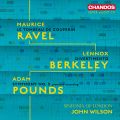
Ravel, Berkeley, Pounds
 Format: CD
The three composers whose works appear on this album are interconnected: Ravel was a mentor to Lennox Berkeley, and Berkeley to Adam Pounds.
Berkeley met Ravel a number of times in the 1920s. Ravel advised him to study with Nadia Boulanger, which he did, between 1926 and 1932. Commissioned by Sir Arthur Bliss for the BBC Symphony Orchestra in 1942, the Divertimento has found many supporters (including Pounds). The critic Peter Dickinson felt it showed an ‘instinctive and unimpassioned creativeness associated with the French aesthetic, but by no means restricted to it’.
Adam Pounds studied privately with Berkeley in London during the late 1970s, and in his own music has perpetuated the firm commitment of the two earlier composers to clarity and accessibility in everything they wrote. His Third Symphony was written in 2021 and is a response to the national lockdowns in 2020 and 2021 prompted by the Covid-19 pandemic. Pounds states that the piece captures the ‘sadness, humour, determination and defiance’ which everyone faced at this time – not least musicians. Scored for relatively modest orchestral forces, the work is dedicated to Sinfonia of London and John Wilson who here give the work its world première recording.
'Le Tombeau de Couperin' marks Ravel’s movement towards neoclassicism, its forms and style a re-invention of ones from the French baroque. Originally written for solo piano, the movements of the suite were dedicated to friends whom Ravel had lost in the First World War. In 1919 he orchestrated four of the six movements (the version performed here).
(Edited synopsis courtesy Chandos Records)
- Divertimento in Bb (op. 18)
Performed by the Sinfonia of London & John Wilson (conductor)
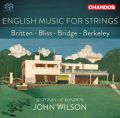
English Music for Strings
 Format: CD
During the 1930s, Bliss, Britten, and Berkeley all contributed major works to the repertoire for string orchestra, following in the footsteps of Elgar and Vaughan Williams. They are joined on this album by Frank Bridge whose Lament was composed during the First World War. This is the fourth recording by John Wilson with his award-winning Sinfonia of London. Bliss composed Music for Strings after he had completed the film score for Korda’s Things to Come, driven by his desire to compose a piece of ‘pure music’, expressing his own ideas rather than those of others.
Commissioned in May 1937 by Boyd Neel for the Salzburg Festival that summer, Britten’s Variations on a Theme of Frank Bridge was composed at great speed, and helped to establish the young composer’s international reputation. Dedicated to his teacher, Frank Bridge, the theme is taken from the second of Bridge’s Three Idylls for string quartet.
Lennox Berkeley composed his Serenade for Strings at Snape Maltings, where he was living with Britten in 1938 / 39. By the time of its completion the nation was at war and the music seems to reflect the composer’s anxious mood as the world faced an uncertain future.
The album is recorded in Surround-Sound, and available as a hybrid SACD. The front cover features a painting by Edward Wadsworth of Bliss’s house, Pen Pits, built for him in 1935.
Synopsis by Chandos Records
- Serenade (op. 12)
Performed by the Sinfonia of London & John Wilson (conductor)
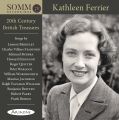
Kathleen Ferrier: 20th Century British Treasures
 Format: CD
SOMM Recordings’ acclaimed series of re-mastered recitals by the fondly remembered singer continues with Kathleen Ferrier: 20th Century British Treasures. This features recordings made for Decca and the BBC between 1946 and 1953 and includes a previously unpublished recording of Ferrier’s passionate performance of Lennox Berkeley’s Four Poems of St Teresa of Ávila. ... Sir Thomas Allen, the distinguished interpreter of British song and Trustee of the Kathleen Ferrier Awards, contributes an extensive booklet commentary. Pianist Julian Jacobson, son of composer Maurice Jacobson, whose melancholy but sensuous The Song of Songs is heard in a 1947 BBC broadcast, also provides a personal poignant note on Ferrier’s championing of his father’s work. The music is sung with all the passion and tenderness we have come to expect from that glorious contralto voice, confirming Our Kaff’s reputation as a warm-hearted, vivacious, modest and courageous woman with a wicked sense of humour.
Review by John Pitt, New Classics
- Four Poems of St. Teresa of Avila (op. 27)
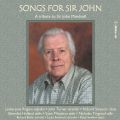
Songs for Sir John - A Tribute to Sir John Manduell
 Format: CD
Sir John Manduell was a pivotal figure in British music - as composer, teacher, BBC producer, first principal of the Northern Royal College of Music and founder of the European Opera Centre. Beloved and revered by musicians, yet someone whose name is shamefully little known outside the music profession.
This album in tribute presents works by 16 composers from more than one generation, centred around settings of W.B. Yeats and principally songs with oboe, recorder, violin and cello. The music is varied, rich and wonderfully set to the texts, and yet the textures are always transparent and clear; there is nothing inherently ‘difficult’ for the listener. The performers are among the cream of the Music world of Northern England, and also, in the Robin Walker Nursery Rhymes (the only work not specially recorded for the album), feature the iconic veteran BBC presenter Richard Baker. Many of these artists have starred in several other Divine Art and Metier albums - click their names above for details.
Even without the Manduell connection this is a wonderfully constructed program of new chamber music.
- Three Pieces
